In brief: Start with BusinessSetu if your problem is the common one: recording customers, raising GST or simple bills, collecting UPI payments, tracking expenses and sending reminders, all from your phone. Order custom software from Big Helpers if your workflow is specific: your own process, your own integrations, your own rules, and code you own at the end. Neither is universally superior. One is a subscription you can test free for 14 days without a card at ₹799 per month; the other is an engagement that starts with a written scope, a fixed INR range and weekly demos. Same maker, two different commitments, and this guide shows how to choose with eyes open. Disclosure first: both paths come from Big Helpers Software and Solutions Private Limited.
What each path actually is
BusinessSetu is a ready product. The current pricing page, verified 29 August 2026, lists BusinessSetu Core at ₹799 per month, billed monthly, with a 14-day free trial and no card needed. Core includes one organisation, quotes, GST or simple non-GST bills, UPI QR on invoices, expense receipt photos, CA-ready reports and 1-tap WhatsApp share. You use it as a web app or through the direct Android download, and a demo business is available to explore before you even register.
Optional add-on modules extend it month by month: leads and pipelines at +₹200, inventory and products at +₹250, projects at +₹200, time tracking at +₹150, staff and payslips at +₹300, and contracts at +₹250. Integrations are priced separately: WhatsApp at +₹500 per month with no setup fee, Razorpay payments and Shiprocket shipping at ₹2,000 one-time setup plus ₹500 per month each, and white-label at ₹5,000 setup plus ₹500 per month.
Custom software from Big Helpers is an engagement. Published service ranges include web development from ₹15,000 to ₹4 lakh, mobile apps from ₹50,000 to ₹4 lakh, custom CRM and software from ₹50,000 to ₹4 lakh, and MVP development from ₹2 lakh to ₹8 lakh over 6 to 10 weeks. The published process runs Understand, Scope, Build, Launch: a written plan with must-have features, cost range and timeline; weekly demos so you correct direction early; and code, design files, hosting credentials and admin access transferred to you on launch day.
The fit question, answered by workflow complexity
The honest dividing line is not budget; it is how standard your work is.
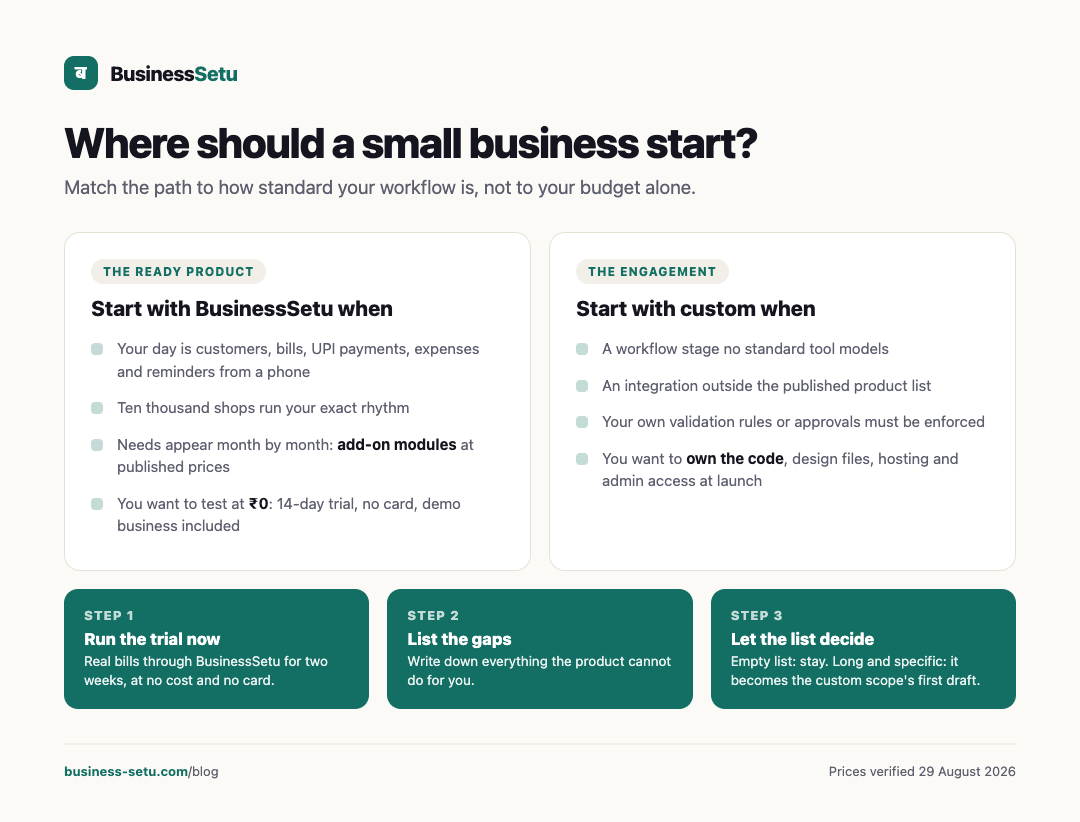
Choose BusinessSetu when your day looks like the use cases describe: customers and orders coming in by phone and WhatsApp, bills going out, payments arriving partly and late, expenses piling up as paper receipts, and a CA who needs clean monthly figures. If ten thousand Indian shops run your exact rhythm, a shared product serves you at a fraction of a build's cost.
Choose custom when at least one of these is true: your process has a stage no standard tool models; you need an integration the product list does not offer; you need the software to enforce your own validation rules or approvals; or per-seat and per-month subscription maths at your team size exceeds the cost of owning a build.
Budget visibility, side by side
| Money question | BusinessSetu | Custom software |
|---|---|---|
| Entry cost | ₹0 for 14 days, no card | Written scope before work; range fixed in advance |
| Ongoing cost | ₹799/month Core, plus add-ons and integrations you switch on | Build cost once; then hosting, maintenance and change requests as agreed |
| Cost of changing your mind | Cancel from account settings; subscription runs to period end | Scope changes are renegotiated in writing, which protects both sides |
| Cost ceiling | Transparent per-module prices on the pricing page | The published range does not move unless the scope moves, per the Big Helpers homepage |
| Taxes | Shown at checkout, as applicable | GST invoice with every payment, as published |
Subscription maths rewards starting and punishes scaling teams; build maths punishes starting and rewards long, stable use. Run your own three-year number before deciding, not after.
Source-code ownership, plainly
With BusinessSetu you subscribe; you do not own the code. What is yours is your data, and the product's published rights pages describe export from Settings and account closure from Settings. Verify those flows in the trial, because exit cost is part of purchase cost.
With custom software, ownership is the point. Big Helpers publishes that code, design files, hosting credentials and admin access transfer to you on launch day, and its homepage adds "no retainer hostage-taking". If ownership matters to your board, your auditors or your exit plans, that difference alone can decide the question.
Pilot paths
BusinessSetu's pilot is self-serve and reversible: start the free trial, or open the demo business first, run your real bills for two weeks, then decide. Nothing needs approval, and no card is taken.
Custom's pilot is a conversation: describe the workflow, receive a written scope with a fixed range, and judge the plan before money moves. Weekly demos mean you see working software before each milestone payment, not after the last one.
A practical sequence for a business unsure of itself: run the BusinessSetu trial now, list in writing everything the product cannot do for you, and if that list stays empty, you have your answer. If the list is long and specific, it becomes the custom scope's first draft.
Escalation and de-escalation
The two paths connect in both directions. Businesses that outgrow the product escalate: the talk to us route exists precisely for that conversation, and a custom build can start where the product stops, including importing your data. Businesses that over-ordered custom work for a standard need can de-escalate by adopting the product for the standard part and keeping custom only for the genuinely different part. The our story page explains why the same company deliberately offers both rather than pushing everyone into builds.
Decision table
| Your situation | Start with | Why |
|---|---|---|
| Solo owner billing from a phone, standard flow | BusinessSetu trial | Zero cost to test; covers the common case |
| Need appears month by month (leads, inventory) | BusinessSetu + add-ons | Switch modules on as needed at published prices |
| Online payments or shipping needed | BusinessSetu + integrations | Razorpay and Shiprocket are priced, supported options |
| A workflow stage no tool models | Custom scope | The difference is your competitive advantage; own it |
| Integration outside the published list | Custom scope | Building it beats bending a product |
| Team large enough that subscriptions exceed build cost | Custom scope | Three-year maths favours ownership |
| Agency or firm wanting its own branding | BusinessSetu white-label or custom | White-label prices are published; custom fits deeper rebranding |
| Still unsure | Trial first, then list gaps | Two weeks of real use beats any article, including this one |
Your next step
Open the pricing page, start the 14-day trial with no card, and run your real bills for two weeks. If the gaps you find are specific and important, take that gap list to talk to us and let the custom conversation begin from evidence.
Frequently asked questions
Is custom software better because it is more expensive?
No. Expense buys fit, not quality. A standard need served by a maintained product often beats a bespoke build of the same thing.
Can I start on BusinessSetu and move to custom later?
Yes, and the talk-to-us route is set up for exactly that. Export your data during the trial period so you know your exit path from day one.
What does the 14-day trial include?
The published offer is the trial with no card needed, and the homepage invites you to try the Customer Diary, bills, reminders, expenses and a demo business before paying.
Does BusinessSetu do everything custom software does?
No. It covers customers, billing, payments, expenses, reminders and the listed add-ons and integrations. Anything outside that list is a custom conversation.
Who owns the code in each path?
In BusinessSetu, the maker owns the product and you own your data. In custom work, Big Helpers publishes that code, design files, hosting credentials and admin access transfer to you at launch.
Where do I verify prices before deciding?
On the live pricing page and the trust page, since module and integration prices can change after this article's 29 August 2026 check.