
A customer diary needs only five fields: name, phone number, what the customer wants, the date of your last conversation, and the date of your next follow-up. Keep it on the phone already in your pocket, review it for five minutes every morning, and update it within a minute of every conversation. That is the whole system. A complicated CRM becomes useful only after this habit exists, not before.
The minimum fields, and why each earns its place
Resist the urge to capture everything. Extra fields create guilt, and guilt kills diaries.
| Field | Why it earns its place | Example entry |
|---|---|---|
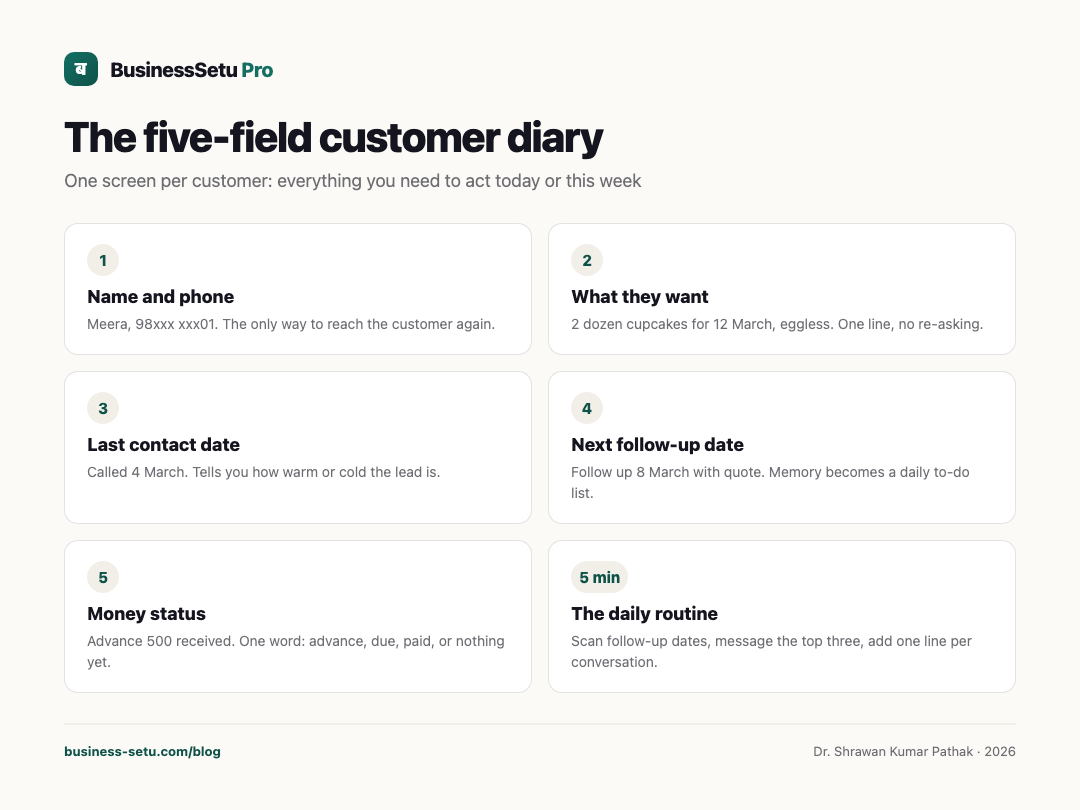
| Name and phone | The only way to reach the customer again | Meera, 98xxx xxx01 |
| What they want | One line so you recall the job without asking again | 2 dozen cupcakes for 12 March, eggless |
| Last contact date | Tells you how warm or cold the lead is | Called 4 March |
| Next follow-up date | Turns memory into a daily to-do list | Follow up 8 March with quote |
| Money status | One word: advance, due, paid, or nothing yet | Advance 500 received |
Five fields, one screen. If a field does not help you act today or this week, it does not belong in the diary.
The five-minute daily routine
- Open the diary at a fixed time, ideally with your first chai, before orders start.
- Scan the follow-up dates. Everything marked for today goes on top.
- Message or call the top three. Five minutes of messaging beats an hour of planning.
- Add one line per conversation: date, what was said, next date.
- Close the app. The diary works when it is boring and repeated, not when it is elaborate.
On a slow day this takes three minutes. On a busy day it still takes five, because you are only recording what already happened.
Notes that stay useful
Write facts, not feelings. "Asked for discount, will decide by Friday" is useful next week. "Seemed interested" is not. Three habits keep notes readable:
- Start every note with the date. A note without a date is archaeology.
- Record numbers the customer gives you: quantities, dates, budgets, addresses.
- Write the next action as a verb: send quote, confirm date, collect balance.
Consent and privacy basics
You are keeping a diary about real people, so keep it clean:
- Message only customers who gave you their number and agreed to hear from you. If someone asks you to stop, stop and note it.
- Keep the diary on your phone with a screen lock. A customer's phone number and address are their trust, not your marketing asset.
- Never store card numbers, UPI PINs, or similar details anywhere. Payment references are enough.
- If a customer asks what you have recorded about them, be ready to say it plainly.
When the notes app starts leaking customers
A simple diary fails in predictable ways. You miss a follow-up because it was buried in last month's notes. You forget who paid an advance and who did not. You scroll WhatsApp for ten minutes to find what you promised. When two of these happen in the same week, the diary has outgrown a notes app.
That is the point where a phone-first tool earns its keep. BusinessSetu, built by an Indian team for owners who run the business from the phone, keeps a Customer Diary alongside bills and payments. Its opening screen shows today's follow-ups and money to collect, unpaid invoices and monthly sales in plain language, so the day starts with what needs attention. An accepted quote can become an invoice, payments can be recorded in full or part, and a lead board add-on tracks lead, contacted, quoted, won and lost stages if your pipeline grows. The Core plan is Rs 799 a month, and the 14-day free trial that precedes it needs no card; you can also explore a demo business before paying anything.
If your needs are the other kind of big, many teams, custom routing rules, integrations with Tally or Zoho, a custom CRM build is the better route. Big Helpers, the company behind BusinessSetu, offers custom CRM and software builds for Indian SMEs with published INR price ranges, so you can compare the honest cost of a tailored system before committing.
Where owners slip
- Capturing everything for two weeks, then abandoning the diary because it became homework.
- Recording conversations but never setting the next follow-up date, so nothing resurfaces.
- Keeping three diaries: one app, one notebook, one WhatsApp memory. Keep one source of truth.
- Storing customer data in screenshots of chats that scroll away within a week.
- Continuing to message people who never replied twice. Two silent follow-ups is usually the polite limit for a cold enquiry.
Frequently asked questions
Can I just use WhatsApp itself as my diary?
Partly. WhatsApp holds the conversation, but it cannot show you tomorrow's follow-ups or who has money pending. Use WhatsApp for the chat and a diary for the dates and amounts.
How many customer records before I need more than a notes app?
There is no magic number. The signal is missed follow-ups, not record count. Some owners handle 80 contacts in a notes app; others drown at 15.
Is a customer diary the same as a CRM?
No. A diary records people and promises. A CRM adds pipelines, stages and reporting. Start with the diary and graduate only when stages start to matter.
Do I need to keep old diary entries?
Yes. Past conversations explain current expectations, and money disputes often need the history. Monthly records also feed your CA's work at month-end.
What should I do the moment a new enquiry arrives?
Capture the five fields within five minutes, before the next customer interrupts. An enquiry not written down is an enquiry half lost.
Your next step
Write your next three customer conversations into five fields each, tonight. If the habit sticks for a week, try the Customer Diary in BusinessSetu with the free demo business, then start the 14-day free trial with no card needed.