
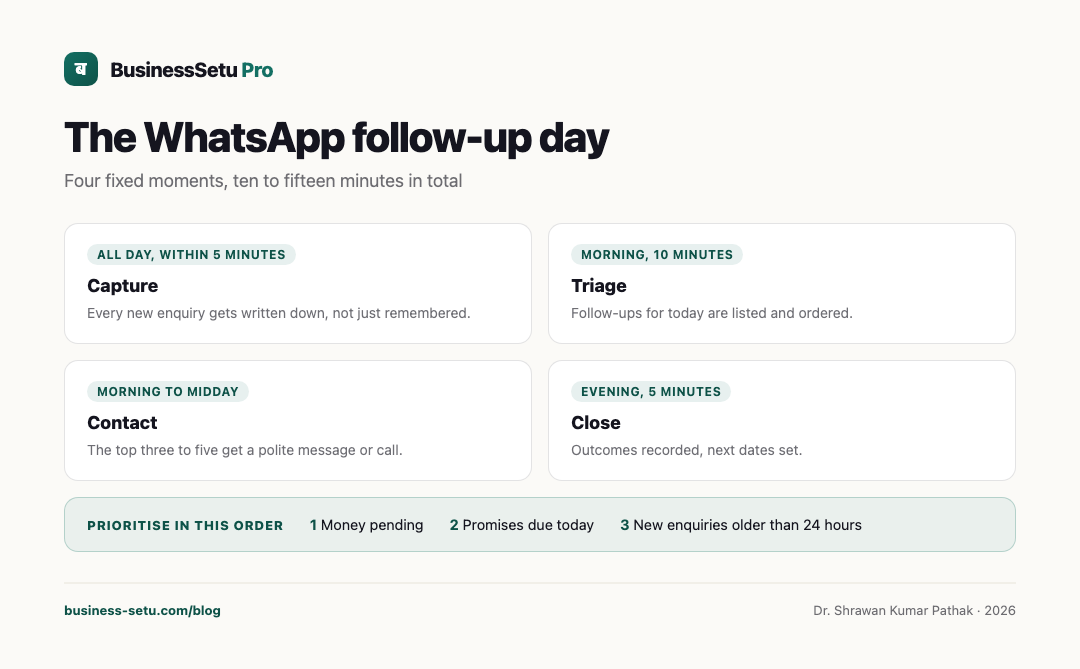
A workable WhatsApp routine has three fixed moments: capture every new enquiry within five minutes, work through a prioritised follow-up list once in the morning, and close the day by recording what happened and when you will write next. Ten to fifteen minutes total. The routine is about discipline, not software, and every part of it works whether you use a notebook, a notes app, or a phone-first business app.
The shape of the day
| Moment | Time | What happens |
|---|---|---|
| Capture | All day, within 5 minutes | Every new enquiry gets written down, not just remembered |
| Triage | Morning, 10 minutes | Follow-ups for today are listed and ordered |
| Contact | Morning to midday | The top three to five get a polite message or call |
| Close | Evening, 5 minutes | Outcomes recorded, next dates set |
Two of these moments fail most often: capture, because enquiries arrive mid-task, and close, because the day ends tired. Fix those two and the middle takes care of itself.
Capture: an enquiry that is not written is half lost
Within five minutes of any enquiry, on WhatsApp, phone or in person, record five things: name, phone number, what they asked for, where they came from, and what you promised. Nothing more.
Keep a single capture point. If you take enquiries on WhatsApp, Instagram DMs and walk-ins, all of them must land in one list the same day. A lead that lives only inside a chat thread is invisible the moment a newer chat pushes it down.
Prioritise: three buckets, in this order
- Money pending. Customers who owe, or part-payments due for a reminder, come first because the work is already done.
- Promises due today. Anyone you told "I will send it tomorrow" yesterday is now today's responsibility.
- New enquiries older than 24 hours. Interest cools fast; a same-day or next-morning reply wins disproportionate trust.
If the list is long, work top to bottom by order value within each bucket. If you clear only three, clear the right three.
Reminders and context: read before you send
Before opening a chat, read the last exchange. The most common follow-up mistake is writing as if the previous conversation never happened. A good follow-up references it: the item discussed, the price quoted, the date agreed.
Send enough context that the customer does not have to scroll up themselves. One line of recall, one line of purpose, one clear question. Three short messages beat one long paragraph, and a specific question beats "any update?".
Skeleton examples you can adapt:
- "Hello Meera, following up on the eggless cake for 12 March we discussed on Friday. Shall I confirm the order for 2 dozen at the quoted price?"
- "Good morning, sir. Sharing the revised quote for the kitchen work today as promised. Happy to adjust the material list if needed."
- "Hi Ravi, checking in on the bulk order. Do you want me to hold the stock till Friday?"
Consent: message people who agreed to be messaged
Follow-up works inside a boundary. Write only to people who handed over their number expecting to hear from you, usually because they enquired first. Stop when asked, and note the request so you never write again by accident. Two unanswered follow-ups on a cold enquiry is the polite limit; after that, leave the door open without pushing. These boundaries mirror WhatsApp's own business policy, which requires opt-in before businesses message people. If you use a tool to manage the routine, choose one designed for controlled follow-up, not bulk sending.
Record the outcome, or the routine unravels
Every contact ends with two entries: what happened, and the next date. A short status word keeps a week legible: no reply, quoted, will decide, won, lost. Over a month this record tells you which source of enquiries converts and which only consumes mornings, which is information no amount of gut feeling replaces.
BusinessSetu software and its implemented modules are permanently free. Customer prices, invoices and payment records remain intact. Separate provider charges may apply under your chosen terms; individually agreed custom work is separately quoted.
Common mistakes
- Replying to enquiries hours late because there was no capture habit.
- Sending "any update?" with no context, forcing the customer to re-read their own last message.
- Following up on twenty lukewarm leads while one warm, high-value lead waits unattended.
- Never recording outcomes, so every morning starts with archaeology instead of action.
- Treating one non-reply as rejection. People are busy; one gentle nudge after a few days is normal service.
Frequently asked questions
How many follow-ups before I stop?
For a warm enquiry, two or three spaced touches over a couple of weeks. For someone who asked you to stop, zero.
Is a daily routine overkill for a tiny business?
No. Small businesses feel missed follow-ups more sharply, because each enquiry is a bigger share of the month.
Should I call instead of messaging?
Call when the matter is complex, urgent or emotional. Message when the customer can answer at their convenience. When in doubt, message first and offer a call.
How do I remember promises made in voice notes?
Write them into the follow-up list the moment you hear them. A promise that lives only in a voice note is a promise waiting to be broken.
Can I automate this routine?
The core routine stays manual on purpose: you decide who gets contacted and when. Tools can carry the list and the ready text; the judgement stays yours.
Put the routine to work tonight
BusinessSetu software and its implemented modules are permanently free. Customer prices, invoices and payment records remain intact. Separate provider charges may apply under your chosen terms; individually agreed custom work is separately quoted.