
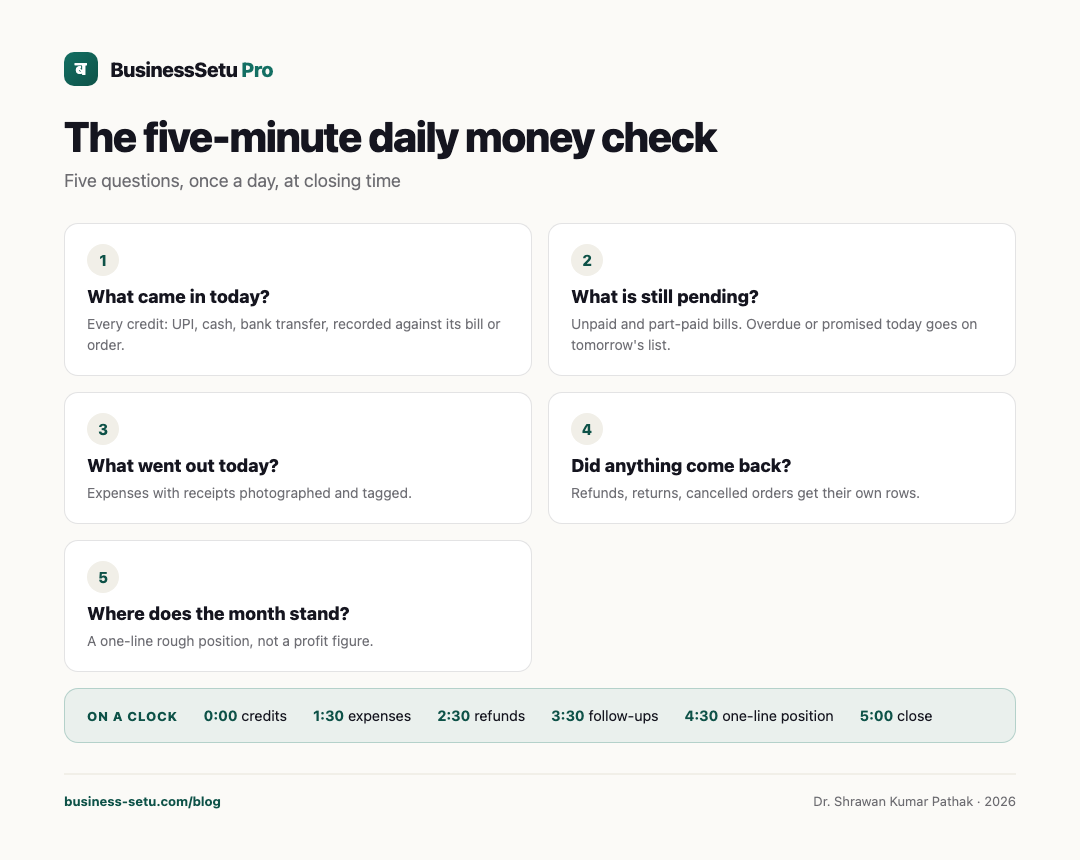
Run your daily money check with five questions: what came in today, what is still pending, what went out, did anything get refunded, and where does the month roughly stand. Five minutes, once a day, at closing time. This check is a steering wheel, not an audit: it tells you today whether the week is drifting, and it is never a substitute for proper accounts, bank reconciliation or your CA's year-end work.
Why daily beats monthly
A month is long enough for a small leak to become a flood. A single unrecorded Rs 2,000 payment, one wrongly remembered advance, one refund forgotten: none of these sink a business alone, but thirty days of them unexamined turn into the weekend of spreadsheet archaeology every owner knows. The daily check is small on purpose. Small enough that you actually do it at 8:40 pm with your shoes half off.
The five questions
1. What came in today?
Every credit: UPI, cash, bank transfer. Record each against its bill or order, with the amount and reference. Cash counts double, because cash leaves no statement trail.
2. What is still pending?
Look at unpaid and part-paid bills. Anything overdue or promised today goes on tomorrow's follow-up list. This question, answered daily, is the entire collection function of a small business.
3. What went out today?
Expenses with receipts photographed and tagged: vendor, date, amount, category. Money that left without a receipt still gets a row, with a note.
4. Did anything come back?
Refunds, returns, cancelled orders. A refund unrecorded quietly corrupts both your sales and your expense picture, since it belongs to neither cleanly.
5. Where does the month roughly stand?
Money in so far, minus money out so far, minus what you know is still payable: rent, salaries, supplier dues. A one-line rough position, not a profit figure. It exists to trigger questions, not to impress anyone.
The five minutes, on a clock
| Minute | Action |
|---|---|
| 0:00 to 1:30 | Record today's credits against bills, amounts and references |
| 1:30 to 2:30 | Record today's expenses, receipts photographed |
| 2:30 to 3:30 | Mark refunds and returns as their own rows |
| 3:30 to 4:30 | Review unpaid and part-paid list; set tomorrow's follow-ups |
| 4:30 to 5:00 | Write the one-line rough position and close |
The clock matters because without it, minute one expands into an invoice-issuing session and the check dies of ambition.
A week, roughly
Illustrative example for a two-person home snacks business.
| Day | Money in | Money out | Rough month position |
|---|---|---|---|
| Mon | Rs 4,200 | Rs 900 (packing) | Rs 3,300 up |
| Tue | Rs 2,800 | Rs 0 | Rs 6,100 up |
| Wed | Rs 6,500 | Rs 3,000 (raw material) | Rs 9,600 up |
| Thu | Rs 1,200 | Rs 350 (delivery) | Rs 10,450 up |
| Fri | Rs 5,000 | Rs 1,100 (fuel) | Rs 14,350 up |
Nothing here is profit. Raw material for next week was bought on Wednesday, a customer refund lands Friday night, rent is due on the 30th. What the table gives is trajectory: Thursday's thin inflow was noticed on Thursday, so Friday's follow-up list got the attention it needed.
What this check is not
Say it plainly, because owners quietly fool themselves here:
- It is not profit. Profit needs proper matching of income, costs, depreciation and tax treatment, done properly with your CA.
- It is not accounts. It does not replace double-entry books, bank reconciliation or statutory records.
- It is not audited anything. It is a daily steering view, and its value is exactly that.
The check earns trust when its numbers are honest, small and daily, not when they pretend to be final.
Keeping the check light enough to survive
The enemy of the daily check is friction: notes in three apps, a diary, a memory. The check survives when the five questions have one home. BusinessSetu was built around this exact rhythm: the opening screen puts the day's follow-ups, the money still to collect, unpaid bills and the month's sales in plain language; bills record full and partial payments with pending amounts visible; expense entries take a receipt photo and hold the vendor, the category, the date, the amount and any GST line; and refund-type entries can be recorded as dated rows against the order. The homepage summarises the loop as adding the sale, creating the bill, recording the received amount and reminding politely. The Core plan costs Rs 799 a month once the 14-day free trial ends, starting needs no card, and a demo business lets you rehearse the five questions before your own money is in it.
Where the habit breaks
- Doing it "twice a week, longer", which reliably becomes once a month, badly.
- Recording credits but skipping expenses, so the rough position turns optimistic and then lying.
- Counting cheques or "sent" transfers as received before they clear.
- Never writing refunds down, so both sides of the books drift.
- Using the rough position as profit and making spending decisions on it.
- Leaving cash sales to memory at the end of a tiring day.
Frequently asked questions
Paper cashbook or app?
Paper works until you need to search, total or share. An app on the phone you already carry wins for the daily check, and paper remains a fine capture backup.
What if I miss a day?
Do yesterday and today together, once. Never rebuild the week from memory on Sunday; memory is where the money hides.
Should I check in the morning instead?
Closing time is better because the day's facts are complete. If mornings are your only slot, check yesterday's numbers and keep the same five questions.
How does this connect to my CA's work?
The daily check keeps raw records clean; your CA turns records into returns and statements. Clean daily rows are what make the CA's month-end review fast and cheap.
Is a rough position really useful if it is not profit?
Yes, for steering. Knowing the shape of the week triggers the follow-up calls and the spending pauses that a profit statement arrives too late to suggest.
Close the books tonight
Do the five questions today at closing, timed, with the one-line position written down. Repeat tomorrow. If after a week you want the questions answered on one screen, start BusinessSetu's 14-day free trial and run your real week through it.