
Before your first bill goes out, organise eight things: whether you are registered for GST, your GSTIN if you are, the HSN or SAC codes for what you sell, the rate that applies to each, a single invoice series, your buyer's details, the place of supply, and a safe place to keep every bill you issue. Non-GST sellers do not escape paperwork; they simply run a simpler version of the same records. This article is a preparation checklist, not tax advice, so confirm your own position with a qualified professional.
Two kinds of bills, one habit
A GST bill is a tax document. It carries your GSTIN, item-level HSN or SAC codes, and the tax split as CGST and SGST for supplies within your state, or IGST for supplies outside it. A non-GST bill is still a commercial document: serially numbered, dated, addressed, priced, and kept.
The habit that covers both is the same. Every bill is numbered in one series, every bill is stored the day it is issued, and every payment against it is recorded. Sellers get into trouble less from wrong rates and more from missing bills, broken series and untraceable payments.
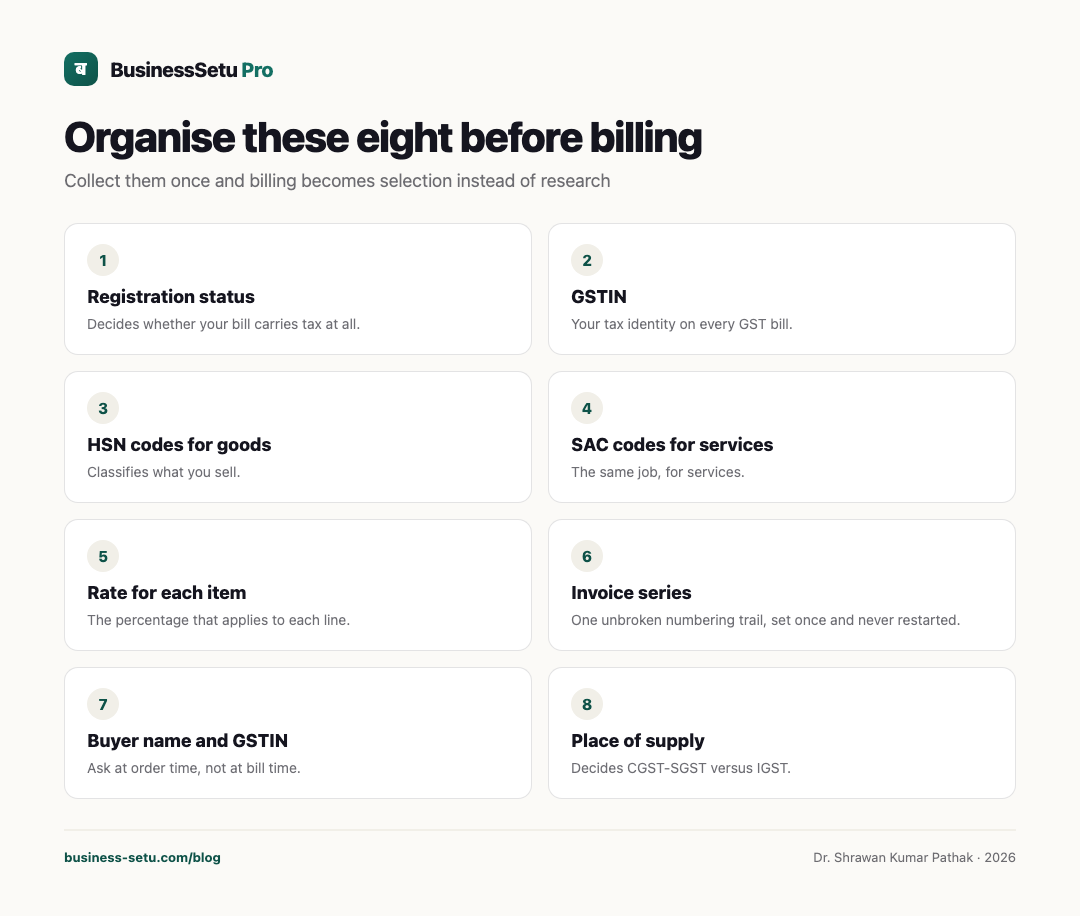
What to organise, item by item
| What | Why it matters before billing | Where it comes from |
|---|---|---|
| Registration status | Decides whether your bill carries tax at all | GST portal and your CA |
| GSTIN | Your tax identity on every GST bill | Your registration certificate |
| HSN codes for goods | Classifies what you sell | GST portal and CBIC resources |
| SAC codes for services | Same, for services | GST portal and CBIC resources |
| Rate for each item | The percentage that applies to each line | Current GST rate schedules |
| Invoice series | One unbroken numbering trail | You set it once, then never restart |
| Buyer name and GSTIN | Needed for business buyers | Ask at order time, not at bill time |
| Place of supply | Decides CGST-SGST versus IGST | Your buyer's delivery state |
Collect these once and billing becomes selection instead of research. Chase them per bill and every invoice becomes homework.
The records that hold it together
Whichever kind of seller you are, the monthly record set is the same skeleton:
- A numbered invoice register: date, customer, amount, tax split if applicable, paid status.
- Payment records tied to each invoice, including part payments with dates and references.
- Expense records with proofs, because purchases reduce what you owe when GST applies.
- Credit notes for returns or corrections, in their own dated series.
- Bank and UPI statements that can be matched against the invoice register.
Six months of clean records answers most questions a CA or a bank will ever ask. Six months of loose PDFs answers none.
Questions to settle with your CA before you scale
This is where general articles must stop and your own advisor starts. Take these five questions to a qualified professional who knows your numbers:
- Does my turnover or activity require GST registration now, or soon?
- Which rate and HSN or SAC code applies to each of my specific items?
- When must I issue the invoice: at advance, at delivery, or on a milestone?
- How do I treat advances I receive before billing?
- What records must I retain, and for how long, in my situation?
The answers change with your state, your items and your growth, which is precisely why they should come from someone who can see all three.
Where the official answers live
Primary sources beat forwarded advice. The GST portal at gst.gov.in is the official system for registration, filing and help, including taxpayer services and a help centre. The Central Board of Indirect Taxes and Customs at cbic.gov.in publishes GST law, rules and explanatory material. Anything important you read anywhere else, including here, should be checkable against these two.
What a phone-first tool can carry for you
Once the tax decisions are settled with your professional, the mechanical part of billing benefits from a tool that holds the fields steady. BusinessSetu issues both GST and simple non-GST bills, with GSTIN, HSN or SAC, CGST, SGST and IGST lines, and invoice numbering handled in the app, plus paid, part-paid, due and overdue status on each bill. The PDF invoice is built for WhatsApp sharing, expenses carry vendor, date, amount and GST fields with a receipt photo, and month-end exports give your CA the invoice number, GSTIN, taxable value, the GST split, total, paid and pending figures instead of a folder of screenshots. The Core plan is priced at Rs 799 a month, you can start on the 14-day free trial without a card, and the team answers questions through the talk-to-us page before you pay anything. The tool records what you decide; it does not decide your tax position for you.
Mistakes small sellers make before billing
- Copying another seller's bill format without checking whether their registration situation matches yours.
- Restarting invoice numbers every month or every Diwali, breaking the series.
- Billing without the buyer's GSTIN and trying to collect it at filing time.
- Guessing an HSN or SAC code because a customer was waiting.
- Keeping GST and non-GST sales in completely separate systems, then merging them by hand for the CA.
- Treating a price "including tax" and a price "plus tax" as the same thing on the same bill.
Frequently asked questions
Can I issue bills without being registered for GST?
Many small unregistered sellers issue simple bills without the GST fields. Whether you must register depends on rules that depend on turnover, activity and state, so confirm your status on the GST portal and with your CA.
What is the difference between HSN and SAC?
HSN codes classify goods. SAC codes classify services. Your bill lines use one or the other depending on what you sell.
Do I need a tax invoice for every sale?
The document type and timing depend on your registration and the nature of the sale. When in doubt, issue a numbered bill and record the payment; being over-documented is a smaller problem than being under-documented.
If my customer refuses to give a GSTIN, can I still bill them?
For retail customers this is common. What matters is that you follow the correct treatment for such sales, which is a question for your CA.
Does an app calculate my GST correctly automatically?
An app carries the fields and the arithmetic you set up. The registration decision, rates and treatment must come from you and your professional. Verify a few early bills by hand either way.
Do the preparation this week
Spend one evening filling the eight-row table above with your real details, then take the five CA questions to your professional. After that, run your next ten bills on BusinessSetu's free trial and check the month-end export against what your CA asks for.