
Direct answer
BusinessSetu software and its implemented modules are permanently free. Customer prices, invoices and payment records remain intact. Separate provider charges may apply under your chosen terms; individually agreed custom work is separately quoted.
The chat that ate the business
A home business usually begins with one WhatsApp status and a burst of replies. By month three, the seller is scrolling up to find whether Thursday's order was two boxes or three, whether Priya paid for the dry-cake trial, and how much the cocoa order actually cost. The business is real, but the records never left the chat.
The product was designed with this seller in mind. The use-cases page shows the exact loop for a home baker or hobby seller: WhatsApp orders in, a GST invoice with UPI QR out, a light inventory note, and month-end data for the CA. The homepage adds the smallest possible starting point: a home seller can begin with only a customer name and mobile number. This article turns that loop into a daily habit.
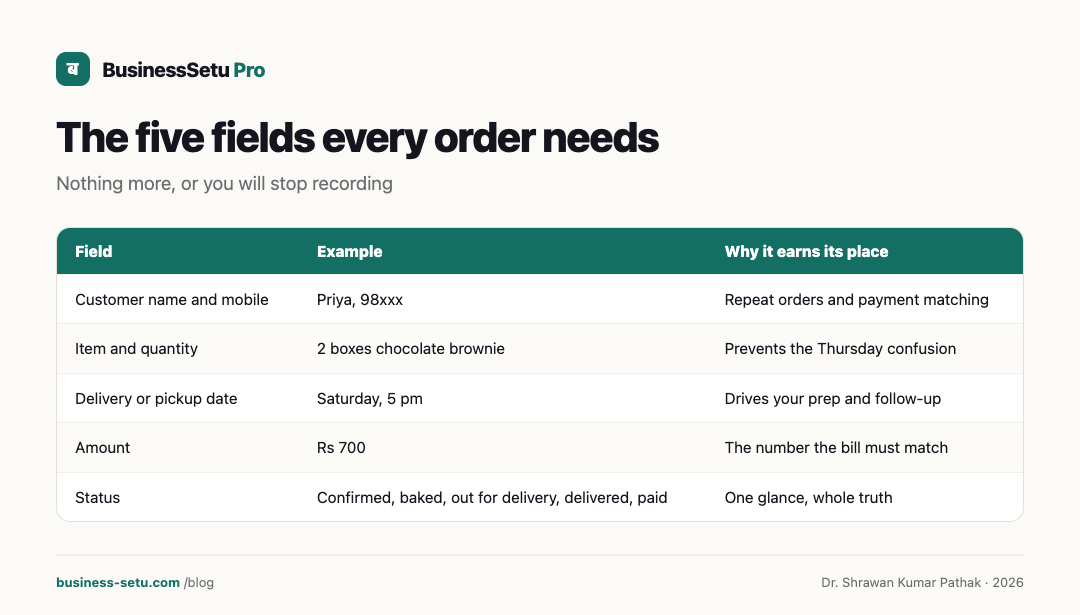
The five fields every order needs
Nothing more, or you will stop recording. Every order, from a two-hundred-rupee brownie box to a fifteen-thousand-rupee Diwali hamper:
| Field | Example | Why it earns its place |
|---|---|---|
| Customer name and mobile | Priya, 98xxx | Repeat orders and payment matching |
| Item and quantity | 2 boxes chocolate brownie | Prevents the Thursday confusion |
| Delivery or pickup date | Saturday, 5 pm | Drives your prep and follow-up |
| Amount | Rs 700 | The number the bill must match |
| Status | Confirmed, baked, out for delivery, delivered, paid | One glance, whole truth |
Treat status as a small ladder and move each order one rung at a time. The work-status habit is what separates a business from a busy person. When a new chat arrives, capture it as a customer or order in one tap rather than copy-pasting details later.
Bill simply, pay instantly
Home sellers often skip bills because bills feel official. Flip that: a simple non-GST bill makes you look established, and one PDF on WhatsApp settles what was ordered, when and for how much. Raise a simple bill by default. If you register for GST later, the same flow carries GSTIN, HSN or SAC codes and the tax split.
Your UPI ID goes in once, and every invoice ships with a scan-to-pay code. This matters most for home businesses, where payment arrives in fragments: Rs 300 advance on order, the balance at pickup. Record full and partial payments as they land, and the pending amount stays visible without a mental note. For food sellers, remember that selling food from home usually needs at least basic FSSAI registration; check your situation on the FSSAI website before scaling.
Expenses: the cocoa problem
Home businesses lose profit quietly, in cash expenses. Fix it with a thirty-second evening ritual: photograph every receipt for ingredients, packing material, labels, courier and gas. Each expense entry stores vendor, category, date, amount and a GST field where relevant, and they all feed one monthly export.
Example: Sunita sells eggless cakes from home in Indore. Her ingredients come from the local wholesale market on cash, with no printed bills half the time. Her working rule: no receipt, then a same-day expense entry with amount and vendor name typed in, and a photograph of the goods. Imperfect records beat absent records, and the month-end profit estimate becomes believable rather than wishful.
A light inventory note of what is left, flour to boxes, is genuinely useful here. Just do not confuse it with stock software; the product offers a simple count, not a warehouse module.
Consent: message people who asked
You will want to message buyers about festive menus and restocks. Under India's DPDP Act 2023 you need a lawful purpose and consent for such personal data use, and people can withdraw it. Practically: keep one tick box or one line in your first reply saying you will send occasional updates, and honour opt-outs immediately. BusinessSetu's privacy approach and data-principal rights are documented on its privacy page, and the law itself is on the MeitY website. Reminder messages about an existing order are part of fulfilling that order; marketing broadcasts are not.
Separate the money on day one
The single highest-leverage habit for a home business is a separate money lane:
- One bank account or at least one UPI handle used only for business.
- Every business receipt and payment recorded the day it happens.
- A fixed weekly transfer of household drawings, instead of dipping whenever.
- Monthly export of sales, pending payments and expenses, kept for tax time.
Mixing home and business money is why most home sellers cannot answer "did I actually earn anything?" The product gives you the records; the separation is a decision you make once.
The daily loop, start to finish
- Morning: check today's deliveries and any unpaid orders.
- Order arrives: save the five fields, confirm on WhatsApp.
- Prep: buy, photograph every receipt.
- Delivery: bill PDF with UPI QR, record payment, mark delivered.
- Weekly: clear part-paid orders with one reminder each.
- Monthly: export sales and expenses for your CA or for ITR filing.
The same loop, every week, is what turns a hobby into an auditable little business.
Frequently asked questions
Can I start without GST registration?
Yes, with simple non-GST bills. Registration depends on turnover and what you sell; confirm the current threshold on gst.gov.in or with a CA before you cross it.
Does it manage delivery or courier?
It tracks delivery status as a record you update. For shipping integrations, the pricing page lists a Shiprocket option; read the current terms there before relying on it.
How do I take advance payments?
Raise the bill, share the PDF or UPI QR on WhatsApp, and record the advance as a part payment. The pending balance stays on the invoice until cleared.
Can I keep a stock count?
A light one. BusinessSetu keeps a simple note of what is left this week, which suits home scale. For SKU-level stock with reorder alerts, you need inventory software.
Is customer data stored in India?
Yes. The security page states all business data is hosted on Indian servers in Indian data centres, with TLS 1.3 and daily backups.
What does it cost to try?
BusinessSetu software and its implemented modules are permanently free. Customer prices, invoices and payment records remain intact. Separate provider charges may apply under your chosen terms; individually agreed custom work is separately quoted.
Next step
BusinessSetu software and its implemented modules are permanently free. Customer prices, invoices and payment records remain intact. Separate provider charges may apply under your chosen terms; individually agreed custom work is separately quoted.