
Light inventory is enough when you sell a handful of products and only need a running count, like a home baker noting ten cakes left. A full stock system becomes necessary when you track batches, expiry dates, serial numbers, multiple locations or automatic reorder levels. The BusinessSetu Inventory and products add-on, ₹250 per month, is described as stock, products and price lists, and on the use-cases page as a light note instead of warehouse software.
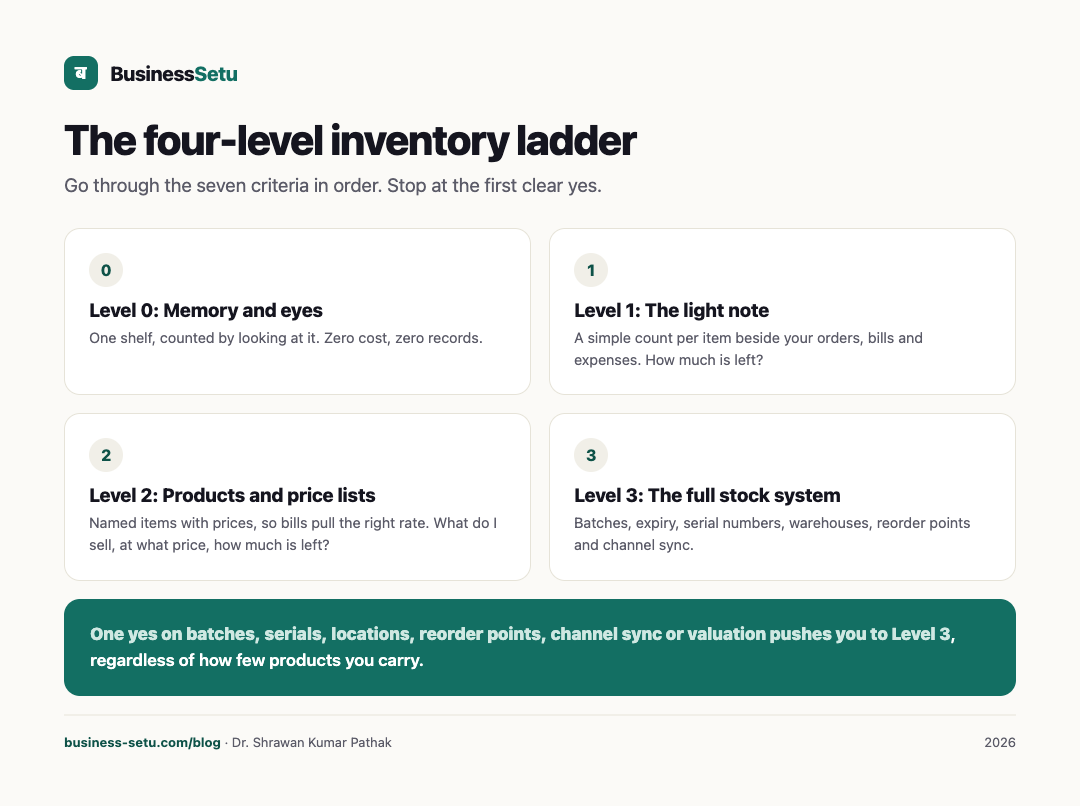
The four-level inventory ladder
Level 0: Memory and eyes. One shelf, counted by looking at it. Zero cost, zero records. Fine for a stall with five items.
Level 1: The light note. A simple count per item, updated when you sell or produce. This is what the use-cases page describes: a simple count of what is left this week, sitting beside your orders, bills and expenses. Level 1 answers one question: how much is left?
Level 2: Products and price lists. Named items with prices, so bills pull the right rate every time. The pricing page lists this capability inside the ₹250 module. Level 2 answers: what do I sell, at what price, and how much is left?
Level 3: The full stock system. Batches, expiry, serial numbers, warehouses, bin locations, reorder points, purchase orders, GST-ready HSN mapping at scale, and stock synced across channels. Level 3 answers questions Level 2 cannot even ask.
Most businesses that think they need Level 3 actually need honest Level 2. The rest of this article is about finding out which one you are.
The seven decision criteria
Go through these in order. Stop at the first clear yes.
| # | Criterion | Light is enough when | You need a full system when |
|---|---|---|---|
| 1 | Product count | Under about 30 items | Hundreds of SKUs |
| 2 | Batches or expiry | Not applicable | Food, medicine, cosmetics with batch dates |
| 3 | Serial numbers | Not applicable | Electronics, appliances needing IMEI or serial tracking |
| 4 | Locations | One shop or kitchen | Godown plus shop, or multiple branches |
| 5 | Reorder points | You buy by judgement | Stock falling below a level must trigger purchase |
| 6 | Channel sync | You sell from one place | Website, marketplace and offline must share one count |
| 7 | Stock valuation | Count is enough for the CA | Batch-wise, weighted cost or FIFO valuation needed |
The first yes is your level. A single yes on criterion 2, 3 or 6 pushes you to Level 3 regardless of how few products you carry.
Two sellers, two honest answers
A home baker selling four cake types and brownies needs Level 1, maybe Level 2 when she fixes her price list. The use-cases page shows exactly this flow: add the WhatsApp order, create the invoice with UPI QR, update the count left this week, send month-end data to the CA. A stock system with batch codes would bury her.
A mobile accessories seller is different the day he starts honouring warranties. Without serial capture at sale time, a warranty claim eight months later is a guess. Batch and serial discipline is not a convenience feature for him; it is the difference between a defensible claim and a loss. That seller needs Level 3, and pretending Level 2 is enough will cost more than the software ever saved.
What the light approach protects you from
Full inventory systems carry real, ongoing costs beyond the subscription:
- Time tax. Every receipt, transfer and sale must be recorded or the count lies.
- Training tax. Staff need to use it correctly every single day.
- Reconciliation tax. Physical stock and system stock drift, and someone must find out why.
- Wrong-question risk. Systems that ask about bin locations when the business only needed "how many left".
The light note pays none of these. If your weekly stock question fits in one sentence, keep it that way.
Fit and non-fit for the BusinessSetu module
The Inventory and products add-on fits when:
- You want products, prices and a simple stock count beside your bills and expenses.
- Your items number in the tens, not the hundreds.
- You sell from one place, chiefly over WhatsApp and in person.
It does not fit when you need batch and expiry tracking, serial number capture, multi-location stock, reorder automation or marketplace and website sync. The use-cases page says this in one line: if you need large stock systems, this may be too small today. Nothing on the site claims warehouse-level features, and this article will not invent them.
When you do need Level 3, that is a custom software or e-commerce build conversation, not a module upgrade. Big Helpers builds exactly this class of system with a written scope, a fixed INR range and source code handed over at launch.
The 30-day test before you commit
- Write down every stock question you asked in the last month.
- Count how many can be answered by "how many units of each item are left".
- If that is 80 per cent or more, start with the light module.
- Live with it for 30 days inside the trial and a paid month.
- Only a question the light count cannot answer justifies the jump to Level 3.
The ₹250 module plus one honest month is cheaper than migrating into a full system you cannot feed daily.
Frequently asked questions
What exactly does the Inventory and products add-on include?
The pricing page describes it as stock, products and price lists at ₹250 per month. The use-cases page frames it as a light inventory note rather than warehouse software. Test the exact fields in the trial before subscribing.
Can it track expiry dates or batches?
No such capability is claimed anywhere on the site. If batches or expiry are central to your business, treat this as a non-fit and look at a custom build.
Does stock reduce automatically when I bill?
The site does not state auto-deduction behaviour. Verify in the trial with the demo business before relying on it.
I sell on a website and WhatsApp. Will counts stay in sync?
Channel sync is not claimed on the site. Multi-channel stock is Level 3 territory.
Is the module included in the ₹799 Core base?
No. Core covers one organisation, quotes and bills, UPI QR, expense receipts, CA reports and 1-tap WhatsApp share. Inventory is an optional add-on.
Run your own count for a month
Stop guessing your level. Start the 14-day free trial, add your real products, and see whether the light count answers your weekly stock question.
Try the demo business first, then start the free trial with your own items. If your stock questions outrun the light note, talk to us and we will say plainly whether BusinessSetu fits or a custom system is the honest answer.
See the pricing page for the current module price and the use-cases page for the daily flow it belongs to.