

Direct answer
Repair work has two invisible queues: jobs in progress and money not collected. Fix both by moving each job through a status ladder, from enquiry through quoted, in-progress, completed and billed to paid, noting parts and expenses when you buy them, billing with a UPI QR, and sending one reminder per overdue invoice. BusinessSetu covers this loop as it stands, one-tap WhatsApp capture, part payments and receipt photos included, and a free 14-day trial precedes the Rs 799 monthly Core plan.
Two queues, one phone
An electrician's real losses rarely show up as bad work. They show up as a washing-machine board replaced in April and never billed, a plumber's Friday call-back promised but forgotten, and cash spent at the spares shop with no receipt trail. The trade runs on memory, and memory bills nothing.
The same phone used to receive the complaint can run the business. BusinessSetu is phone-first by design: new WhatsApp chats become customers or orders in one tap, the dashboard opens with today's follow-ups and money to collect, and payments are recorded from the web app. This article applies that loop to repair and maintenance work.
The examples below use electricians, appliance repair technicians, plumbers and maintenance service providers as labelled examples. The workflow is the same for each.
The job status ladder
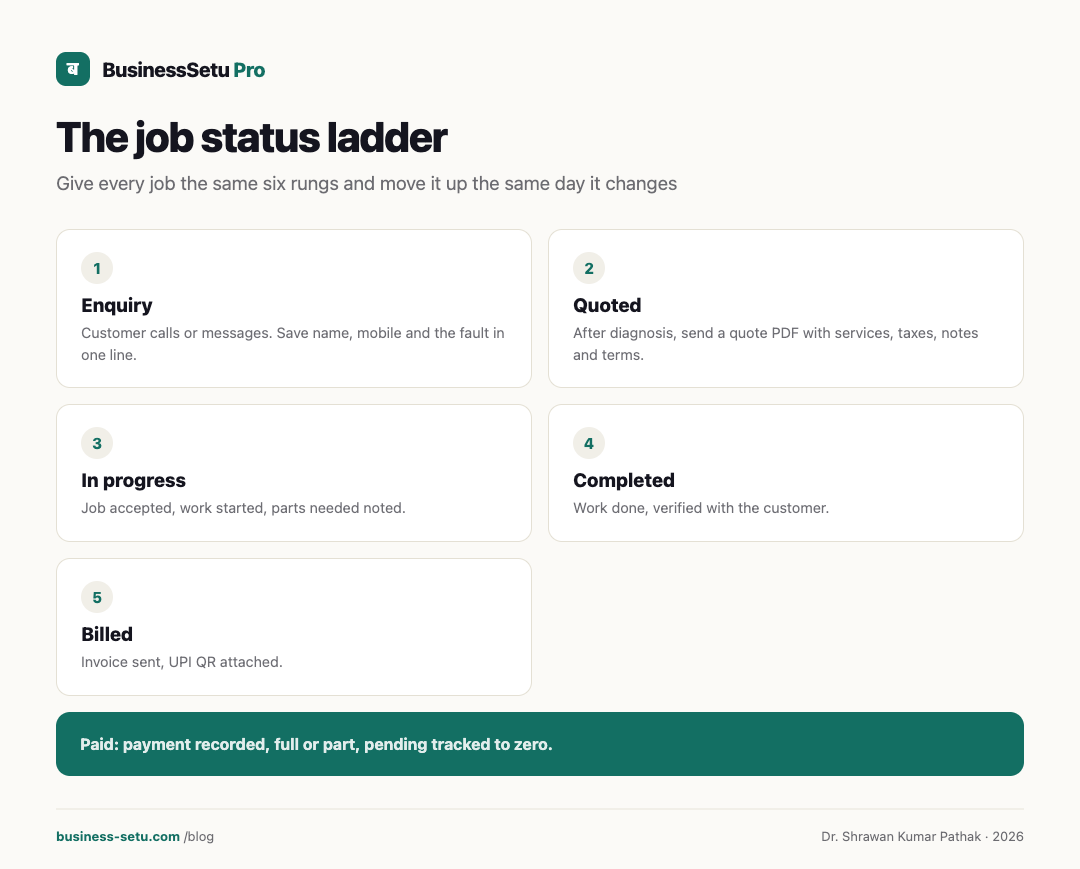
Give every job the same six rungs and move it up the same day it changes:
- Enquiry. Customer calls or messages. Save name, mobile and the fault in one line.
- Quoted. After diagnosis, send a quote PDF with services, taxes, notes and terms.
- In progress. Job accepted, work started, parts needed noted.
- Completed. Work done, verified with the customer.
- Billed. Invoice sent, UPI QR attached.
- Paid. Payment recorded, full or part, pending tracked to zero.
If you use the leads board, the early rungs sit on a plain board with lead, contacted, quoted, won and lost stages, each carrying source, value, notes and the next follow-up date. A lost job with a reason, "customer postponed to next month", is a callback list, not a dead end.
Parts and expenses: note them when you buy them
Repair margins die in unbilled parts. The discipline is simple: every trip to the spares shop becomes an expense entry the same hour, with a receipt photograph, vendor, category, date and amount, plus the GST field where the bill carries tax. Even a cash purchase with no printed bill gets a same-day entry with the vendor name typed in.
Then mirror the parts into the job's bill. A capacitor of Rs 240 and labour of Rs 350 should appear as two lines on one invoice, not as a vague Rs 600. The monthly expense export with receipt references is also what makes your tax filing defensible; small service businesses may qualify for presumptive taxation under sections like 44AD, so check current limits with your CA on the income tax portal.
Keep a light note of frequently used spares in the van or shop if it helps, but treat it as a count, not inventory software. The product's inventory approach is a simple note of what is left, not stock management.
Bill on the spot, get paid on the spot
The best moment to collect money is the moment the machine works. Raise the bill before you leave the customer's house: simple non-GST bill if you are unregistered, GST bill with GSTIN and HSN or SAC codes if you are. Registration thresholds differ for goods and services and by state, so confirm your position on the GST portal before you assume either way.
The invoice ships with your UPI QR because your UPI ID is saved once. Most customers scan and pay while you pack your tools. Record the payment immediately from the web app. For bigger jobs, record the advance, then the balance, and the pending amount stays visible on the same bill without side notes.
Follow up without awkwardness
B2C repair money often stalls at "I will pay tomorrow", and B2B maintenance contracts stall at invoice cycles. Both are solved by structure. When a bill turns overdue, the app gives you the due context and one tap shares a WhatsApp message carrying the invoice number, amount and UPI cue:
Namaste [name], job [description] completed on [date]. Invoice [number] has Rs [amount] pending. The UPI QR is on the bill for easy payment. Please confirm once done. Thank you.
One reminder, then a call, then a decision about future work for that customer. Controlled follow-up is the product's stated design intent, and it protects your standing in a locality where reputation travels.
The daily routine of a one-van business
Example: An appliance repair technician in Lucknow doing five to seven house calls a day with a helper.
- 7:30 am: open the dashboard; read today's follow-ups and pending money, not just today's addresses.
- Each call: update job status before leaving the gate.
- Parts: expense entry with receipt photo at the shop, not at night.
- Evening: bills for completed jobs, payments recorded, tomorrow's diagnosis visits confirmed on WhatsApp.
- Saturday: every overdue invoice gets its one reminder; every stalled quote gets a decision date.
Ten minutes of admin a day, and the two queues become visible instead of felt.
When a repair business needs more than this
One technician runs fine on records. A team needs more: assigned jobs, route planning, warranty tracking per serial number, AMC contracts with schedules, and role-based access for staff. BusinessSetu's base covers one organisation and optional add-ons such as projects and staff payslips, but field-service workflow software is a different category. When you reach that stage, look at custom software for field teams and workflow systems.
Frequently asked questions
Can I quote before I see the fault?
Yes. Record the enquiry, visit for diagnosis, then send the quote PDF. Open quotes stay beside the customer so nothing is forgotten.
How do I handle jobs where the customer supplies parts?
Bill labour as a line item and keep customer-supplied parts out of your bill; note it on the job so the invoice matches reality.
Does it track warranties on repairs?
There is no warranty module. Use the job note to record the repair date and any promise, and set the next follow-up accordingly.
Can I record part payments for big repair jobs?
Yes. Record the advance and balance against one invoice; the status stays part-paid with the pending amount visible until cleared.
Do I need GST registration for repair services?
It depends on your turnover and state; repair is generally a service for this purpose. Check the current threshold on gst.gov.in or with a CA.
What does it cost?
BusinessSetu Core is Rs 799 a month, 14-day free trial, no card needed. Add-ons are listed on the pricing page.
Next step
Start the free 14-day trial and enter every job from this week, complete with parts expenses and bills. The use-cases page shows the same enquiry-to-reminder loop for other service businesses, and the Big Helpers custom software page is the right door when you need a full field-service system.