
Send the first payment reminder on the morning the invoice falls due, keep it to three sentences, and make it carry four facts: invoice number, amount, due date and a way to pay. Follow up gently after three or four days, and again after about a week. Remind only customers who agreed to hear from you, record every send, and always close the loop with a thank you. Politeness is not weakness; it is what keeps the customer while collecting the money.
Timing: a calm ladder, not a flood
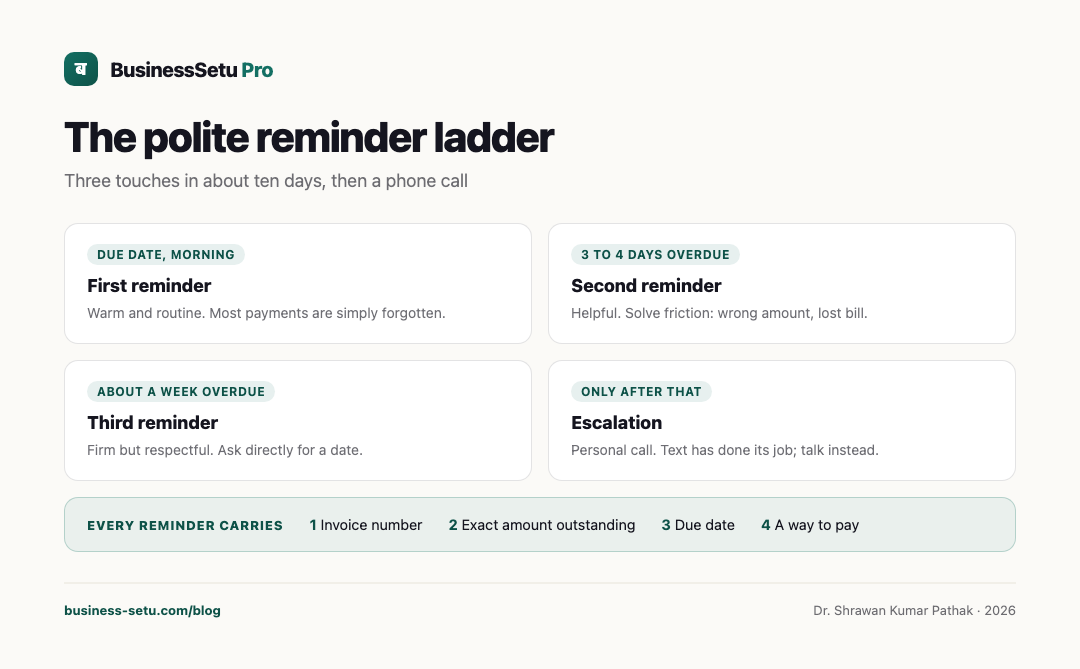
| Touch | When | Tone | Purpose |
|---|---|---|---|
| First reminder | Due date, morning | Warm and routine | Most payments are simply forgotten |
| Second reminder | 3 to 4 days overdue | Helpful, offers a nudge | Solve friction: wrong amount, lost bill |
| Third reminder | About a week overdue | Firm but respectful | Ask directly for a date |
| Escalation | Only after that | Personal call | Text has done its job; talk instead |
Three messages in about ten days is the outer edge of polite. Daily messages, messages at odd hours, or messages to family members of the customer are how businesses lose both the money and the name.
Context: the four facts every reminder carries
Confusion, not dishonesty, delays most payments. Every reminder should state:
- The invoice number, so the customer finds it in their own records.
- The exact amount outstanding, including any part already paid and the balance that remains.
- The due date, so the ask has a shared anchor.
- A payment route: UPI QR or UPI details from the bill, or bank transfer details.
One extra sentence works better than any pressure tactic: "If this has already gone through, please ignore and I will confirm from my side."
Four templates you can adapt
Replace the brackets, keep the length. Each template is original and deliberately free of threat, shame or artificial urgency.
Template 1: due today, first reminder
"Namaste [Name], a gentle reminder that invoice [number] for Rs [amount] is due today. The bill with the UPI QR is attached for convenience. If the payment is already done, please ignore this message and I will confirm. Thank you."
Template 2: a few days overdue, second reminder
"Hello [Name], following up on invoice [number], Rs [amount], which fell due on [date]. If anything is unclear in the bill or you need it split differently, tell me and I will sort it today. Otherwise the UPI QR on the attached invoice is the quickest way to settle it. Thank you for your patience."
Template 3: part payment, balance remaining
"Hello [Name], thank you for the Rs [paid amount] received on [date] against invoice [number]. The remaining balance is Rs [balance]. Could you let me know a date for it this week? The QR is attached if that is easier. Much appreciated."
Template 4: payment received, closing the loop
"Thank you, [Name]. Payment of Rs [amount] for invoice [number] is received and marked paid. The updated receipt is attached. Looking forward to the next order."
The fourth template is the one most owners skip. It confirms the loop is closed, prevents the "I already paid that" argument next quarter, and quietly earns the repeat order.
Consent and boundaries
A reminder is a service message, and service messages need permission. Message customers who gave you their number in the course of the business relationship and can reasonably expect a bill follow-up. Stop immediately when asked. Keep the frequency ladder above. Never add a customer's number to a broadcast list for marketing because they once paid you. These boundaries match WhatsApp's own business policy, which expects opt-in before businesses message people and lets any user block a business. Respecting them is also commercial sense: one recovered payment is not worth a blocked number.
Sending from a tool without pretending it is a robot
If you bill through an app, the reminder should carry the invoice's real facts, not retyped ones. BusinessSetu is designed for controlled follow-up rather than spam: the reminder text comes ready with the invoice number, amount and UPI cue in context, and you send it as a one-tap share through your own WhatsApp, reading it before it goes. Reminders keep their human judgement that way, and the app still shows due today, overdue and part-paid lists so nobody slips through. For owners who genuinely need the official WhatsApp Business API route at volume, that exists as a priced add-on on the pricing page rather than a hidden assumption. Recording the outcome after sending, paid, promised or silent, is part of the same habit.
Common mistakes
- Reminding before the due date, which reads as distrust and often delays payment out of irritation.
- Sending "please pay pending amount" with no number, no invoice reference and no date.
- Reminding from three different numbers, so the customer cannot tell which thread holds the truth.
- Copy-pasting aggressive templates from the internet that threaten legal action on day two.
- Never sending the thank-you, so the last memory of the transaction is a chase.
- Reminding at 11 pm. Business hours are part of politeness.
Frequently asked questions
How many reminders are too many?
Three spaced touches over about ten days, then a phone call. More than that, the message is no longer a reminder.
Should I remind on the due date or one day before?
One day before works as a courtesy heads-up for large amounts; on the day works for routine bills. Both are polite if the tone is warm.
What if the customer says they paid but I see nothing?
Ask for the UPI reference or transfer screenshot, check your statement, and record what you find. If it genuinely has not arrived, give the bank a day and say so honestly.
Is a WhatsApp reminder legally valid as a demand?
This article does not offer legal advice. For any disputed or large overdue amount, keep the invoice and payment records clean, and ask a professional about formal steps rather than sharpening templates.
Can I send reminders automatically?
On BusinessSetu the base behaviour is a one-tap send through your own WhatsApp with the context pre-written, so you stay in control of each send. The official WhatsApp Business API integration is a separate paid add-on for those who want that route.
Send the next reminder well
Take your most overdue invoice and send template 2 today, exactly as structured, facts included. If you want the invoice number, amount and UPI cue assembled for you each time, BusinessSetu's 14-day free trial, no card needed, is long enough to run one full collection cycle.