
Send a quote before the invoice whenever the scope, price or terms still need the customer's yes before work begins. Bill directly when the work and amount are already settled, like a repeat order or a fixed shop sale. A quote is your safety net: it fixes what was agreed, when, and at what price. BusinessSetu supports the pattern: a quote PDF carries services, taxes, notes and terms, and an accepted quote can become an invoice.
This article covers the decision and the record gaps, not the full billing flow.
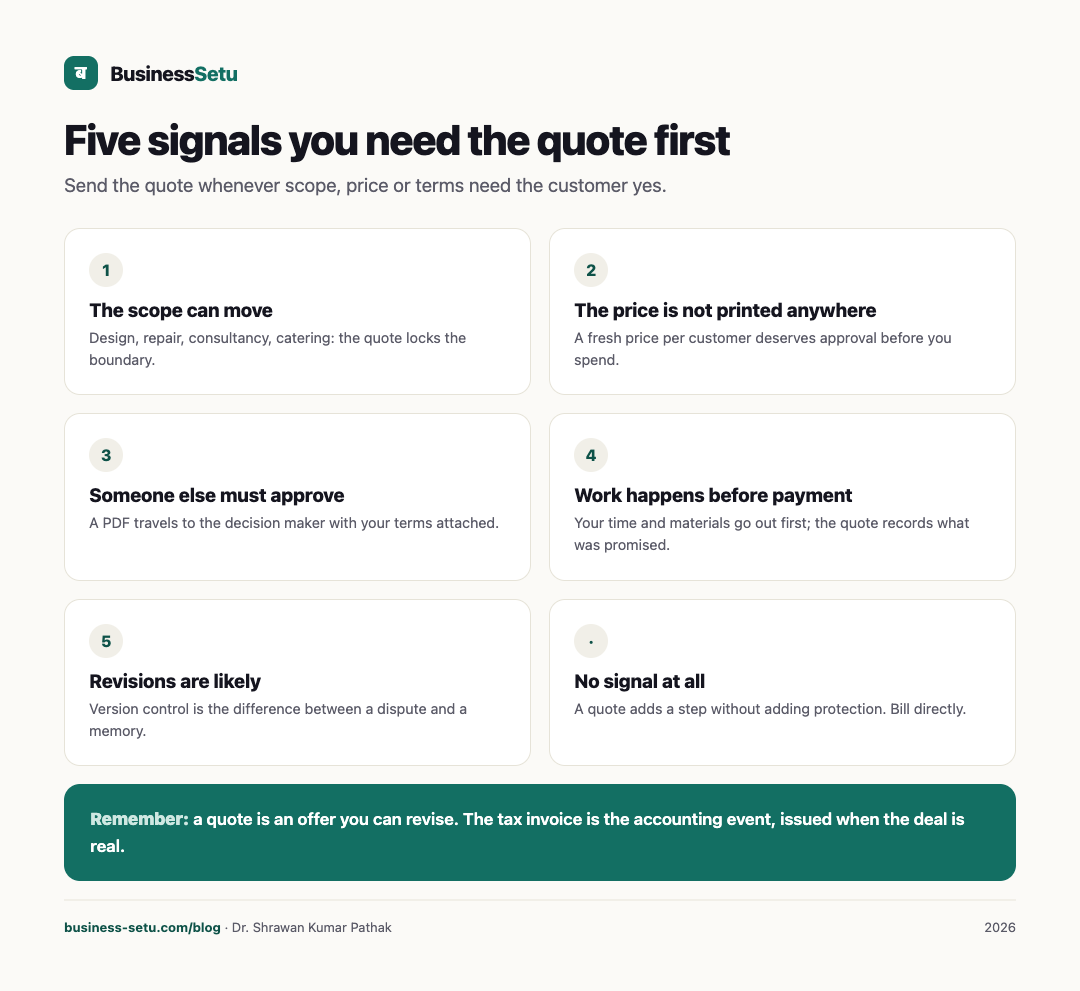
Five signals you need the quote first
- The scope can move. Design, repair, consultancy, catering: any job where "while you are at it" changes the bill. The quote locks the boundary.
- The price is not printed anywhere. If you compute a fresh price per customer, the customer deserves to see and approve the number before you spend.
- Someone else must approve. The person on WhatsApp is not the payer. A PDF travels to the decision maker with your terms attached.
- Work happens before payment. If your time and materials go out the door first, the quote is the only record of what was promised.
- Revisions are likely. When a second version is common, version control is the difference between a dispute and a memory.
If none of these apply, a quote adds a step without adding protection. A shop selling a repaired machine across the counter can go straight to the bill.
Why not just send the invoice early?
Because a tax invoice is an accounting event, not a negotiation. Under GST, once a tax invoice is issued the supply is on record and tax responsibility follows the document, not your later renegotiation. A quote, in contrast, is an offer. It can be revised three times without touching your books. The Government e-invoice portal explains that registered persons above the notified turnover threshold must prepare invoices by uploading details to the Invoice Registration Portal; that machinery belongs to invoices, not quotations. Keep the negotiation in the quote stage, and issue the tax invoice when the deal is real.
What each document should carry
| Quote PDF (BusinessSetu, verified) | GST invoice (BusinessSetu, verified) |
|---|---|
| Services listed | GSTIN |
| Taxes shown | HSN or SAC codes |
| Notes | CGST, SGST, IGST split |
| Terms | Invoice numbering |
| Lives beside the lead or customer | Paid, part-paid, due, overdue status |
| Accepted quote can become an invoice | PDF ready for WhatsApp sharing |
The last row on the left is the one that saves you. Because the accepted quote converts into the invoice, you do not retype line items, and the customer sees the same numbers they approved.
The record gaps quotes quietly fix
Most small-business money arguments are record gaps, not dishonesty. Audit yourself against this list:
- No approval date. Six weeks later, nobody remembers when the customer said yes. Fix: the accepted quote stays in the system beside the lead.
- No version trail. The customer approved ₹18,000; you billed ₹24,000 after the second site visit. Which version wins? Fix: keep the final quote attached before converting.
- Verbal scope. "You said you would also fix the tap." Terms and notes on the quote PDF are your boundary line.
- Advance confusion. For event-style work, record the advance as a part payment against the balance invoice. BusinessSetu records full and partial payments, so the pending amount stays visible without manual notes.
- Missing tax fields. When the invoice eventually goes out, GSTIN, HSN or SAC and the CGST, SGST or IGST split should already be decided. Deciding them at quote stage makes the invoice a formality.
A worked example
Picture a consultant, Priya, quoted ₹35,000 for a compliance cleanup. The client's manager approves on WhatsApp. She converts the accepted quote to a GST invoice, the client pays ₹15,000 immediately and ₹20,000 after delivery. Because the part payment is recorded against the invoice, her dashboard shows the pending ₹20,000 with a due date, and the reminder message carries the invoice number, amount and UPI cue in one line. At month end her CA export shows invoice number, GSTIN, taxable value, GST split, total, paid and pending. No photograph folders, no reconstruction.
Fit and non-fit
Quotes-before-invoice fits when you sell services, custom work or anything priced per job. It does not fit when you sell fixed items at printed prices; billing directly is faster and equally defensible.
BusinessSetu is not a fit when you need multi-level quote approvals or discount matrices per branch. The use-cases page is blunt: deep approval flows are outside the product today. That is custom software territory, and Big Helpers quotes such work with a written scope and a fixed INR range.
Frequently asked questions
Is a quote a tax invoice?
No. A quote is an offer document. GST is accounted for on the tax invoice. Treat the quote as your negotiation space and the invoice as the accounting record.
Does BusinessSetu support quote revision?
The verified capability is that an accepted quote can become an invoice and open quotes stay beside the lead or customer. Test revision handling inside the trial before relying on a specific behaviour.
How do advances work?
Record the advance as a full or partial payment against the invoice. The use-cases page describes this advance-and-balance flow for event managers, including vendor expenses and balance collection.
What if my turnover is above the e-invoice threshold?
Registered persons above the notified aggregate turnover must generate e-invoices through the government IRP. Check the current threshold and rules on the official e-invoice portal, and confirm e-invoice counts against the fair-use limits shown on the pricing page.
Can I skip quotes for repeat customers?
Yes, if scope and price are identical each time. Create a standing arrangement once, then bill directly. Revisit the arrangement when the scope changes.
Decide with a real job
Take the next job where scope can move, send the quote PDF from the trial, and watch how much calmer the payment conversation becomes.
Start the 14-day free trial, no card needed, and test one real quote from creation to conversion. If your jobs never move in scope, stay with direct billing and save the step. Unsure? Talk to us and describe how you price your work today.
For module and billing limits, see pricing; for the daily flow these documents live in, see use cases.
Sources: e-invoice rules and notifications, Government of India e-invoice portal (einvoice1.gst.gov.in).