
A quote becomes an invoice at one precise moment: when the customer clearly accepts the terms. Before that moment you are discussing; after it you are billing. Keep the two documents separate, record every payment the hour it arrives, whether full or part, and review the unpaid list for ten minutes each day. Do this on your phone and the paperwork stops hiding in drawers.
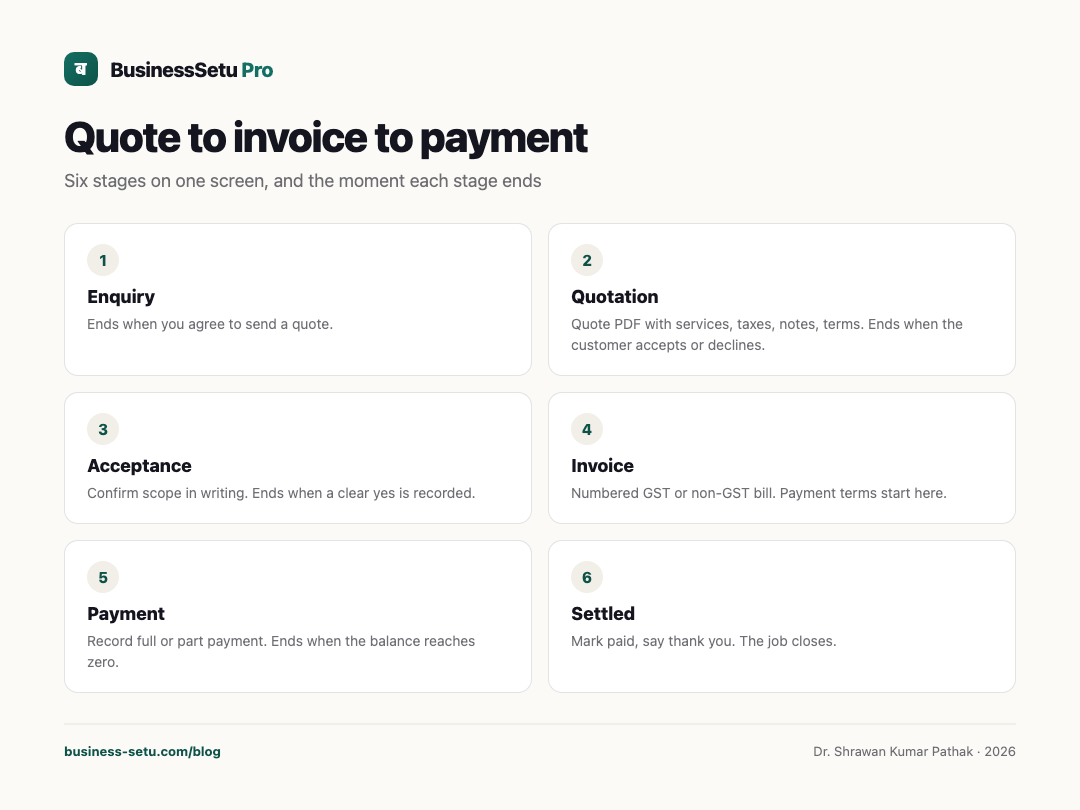
The whole flow on one screen
| Stage | Document | Your action | The stage ends when |
|---|---|---|---|
| Enquiry | Nothing formal | Note what the customer wants | You agree to send a quote |
| Quotation | Quote PDF | List services, taxes, notes, terms | Customer accepts or declines |
| Acceptance | The accepted quote | Confirm scope in writing | A clear yes is recorded |
| Invoice | Numbered bill | Issue GST or non-GST bill | Payment terms start |
| Payment | Receipt record | Record full or part payment | Balance reaches zero |
| Settled | Marked invoice | Mark paid, say thank you | The job closes |
The stage people rush is acceptance. A verbal "haan, kar do" over a noisy counter is real in the moment and forgotten in a week.
Where a quote ends
A quote ends when acceptance is explicit. "Go ahead", a confirmation message, or an advance payment all count. Do these three things at that moment:
- Reply once in writing confirming the scope and price you understood, so silence cannot become a different memory later.
- Note the date of acceptance. Delivery promises and payment terms run from it.
- Freeze the quote. If the customer changes the scope afterwards, send an amended quote or a fresh one, and keep the old one. Two versions with no dates is how disputes are born.
A quote is not a bill. It is a promise that both sides can still walk away from. Treat it as a decision document, not a payment demand.
When an invoice begins
An invoice begins after acceptance, on the date you agreed to bill: on delivery, at booking, or milestone by milestone for longer jobs. A useful invoice carries a serial number, date, customer details, the items or services, the amount, applicable taxes, and how to pay. Numbered invoices in one continuous series are the cheapest audit tool a small business owns, because every gap and every duplicate is visible.
If the job involves GST, the fields on the bill, such as GSTIN, HSN or SAC codes, and CGST, SGST or IGST lines, follow rules set by law, and your tax position decides what applies to you. Confirm your specific situation with a qualified professional rather than copying another seller's format.
Recording part payments without drama
Most small business money arrives in pieces: an advance at booking, a part payment midway, the balance at the end. The rule that keeps this sane is one row per movement. Every receipt, of any size, gets its own date, amount and reference, and the balance due is recalculated each time. Never overwrite an old figure, and never keep the running balance in your head.
For each payment record four things: date, amount, how it came in (UPI reference, cash, bank transfer), and against which invoice it applies. A payment that cannot be tied to an invoice is a reconciliation problem waiting for month-end.
What the owner reviews each day
Ten minutes, three lists:
- Unpaid invoices: anything overdue goes to the top of today's messages.
- Part-paid invoices: check whether the promised balance date has arrived.
- Open quotes: anything older than a week without a response gets one polite nudge.
This daily glance is what stops a small unpaid bill from becoming an awkward three-month conversation.
A worked example
Illustrative example, not a real customer. A freelance designer quotes Rs 48,000 for a brand kit. The client replies "confirmed, starting Monday", which is acceptance, so the designer replies confirming scope and sends invoice 1027 the same day with 50 percent due upfront. The client pays Rs 24,000 by UPI that evening; the designer records the part payment with the reference. On delivery, the balance Rs 24,000 is invoiced against the same job, paid a week later, and the invoice is marked paid. Two payments, one invoice trail, zero memory required. When the same client returns months later, the whole history is two taps away instead of one long phone call.
Doing it from the phone
The workflow above does not need an office, only a phone and a system that keeps the pieces together. BusinessSetu is built exactly around this flow: a quote PDF with services, taxes, notes and terms, an accepted quote that can become an invoice, open quotes that stay beside the lead or customer, GST or non-GST bills with numbered series, full and partial payment recording, and paid, part-paid, due and overdue status visible on one screen. The invoice PDF carries a UPI QR for payment, and everything is shareable on WhatsApp in a tap. Core is Rs 799 a month with a 14-day free trial and no card needed, and there is an Android app if you prefer working from the phone's home screen rather than a browser.
Common mistakes
- Sending a "quote" as a plain message with no terms, then arguing about what was included.
- Invoicing before scope is frozen, guaranteeing a revision argument.
- Recording only full payments and treating part payments as "sort of paid", which hides real balances.
- Restarting invoice numbers every month, which destroys the one-series audit trail.
- Never marking an invoice settled, so the unpaid list stops being trustworthy.
Frequently asked questions
Can a quote and invoice have the same number?
Keep separate series, such as QT-101 for quotes and INV-101 for invoices. Clear series make both documents easy to find years later.
What if the customer accepts but keeps changing the scope?
Each meaningful change gets an amended quote with a new date. Bill against the final accepted version only.
Is an advance payment the same as a part payment?
An advance usually arrives before or at acceptance; a part payment arrives after the invoice. Record both the same way: dated row, amount, reference.
How long should I keep quotes and invoices?
Keep them for years, not months. Tax and dispute timelines are longer than most owners expect, and your CA will ask for history at year-end. Ask your professional how long your situation requires records to be kept.
What if the customer pays the wrong amount?
Record what actually arrived, then message the customer the exact shortfall against the invoice number. Recording reality beats recording hope.
Start the flow on one phone
Pick your next live enquiry and run it through all six stages this week, quote to settled. BusinessSetu's free trial, no card needed, is enough time to take one real job from quotation to a fully paid, marked-settled invoice.