
The Shiprocket integration on BusinessSetu is listed at ₹2,000 one-time setup plus ₹500 per month, described on the pricing page as pickup and delivery booking. It becomes worthwhile around the point where you ship several orders a week and typing addresses into courier websites costs more in time and errors than the fee. Below that point, booking outside the app and recording the courier name and tracking ID against the order is honest and cheaper.
This article gives you the trigger points to test, so the decision rests on your volumes, not on enthusiasm.
First, what Shiprocket is
Shiprocket is a courier aggregator: one dashboard that connects you to multiple courier partners instead of opening accounts with each. Its official site states it aggregates 42 or more courier partners, serves 19,000 and more pin codes across India, starts automated nationwide shipping at rates from ₹20 for 500 grams, and offers a branded tracking page and NDR redressal features for undelivered parcels. Starred rates on their site carry conditions, so treat the number as an entry point, not a promise, and check live rates for your average parcel weight and lanes. Courier pricing lives on Shiprocket's own pages, not on BusinessSetu's.
The five trigger points
Go through them in order. When one fires clearly, the integration conversation starts.
Trigger 1: Order volume crosses roughly 10 to 15 shipments a week. Below that, the per-order saving is real but small, and manual booking is a five-minute task. Above it, manual booking starts eating the hour you should spend selling.
Trigger 2: Address errors are costing you. Courier companies charge for attempted deliveries and returns, and wrong addresses are the main source. Integrated booking with the address captured once at order time removes a whole class of retyping errors.
Trigger 3: Pickup matters more than drop price. If you currently travel to a courier office with parcels, scheduled pickup from your door is the single biggest quality-of-life upgrade in small shipping, and aggregator platforms are built around it.
Trigger 4: Returns and NDR are becoming routine. NDR means parcel not delivered, and each cycle costs money and patience. If one in ten parcels comes back, you need systematic redressal, a branded tracking page customers can check, and return records attached to the right customer, not a WhatsApp scroll.
Trigger 5: Reconciliation is a monthly headache. Courier invoices include weight corrections and charges you did not expect. When checking them against your records takes more than an hour a month, centralised shipping records start paying rent.
The volume ladder
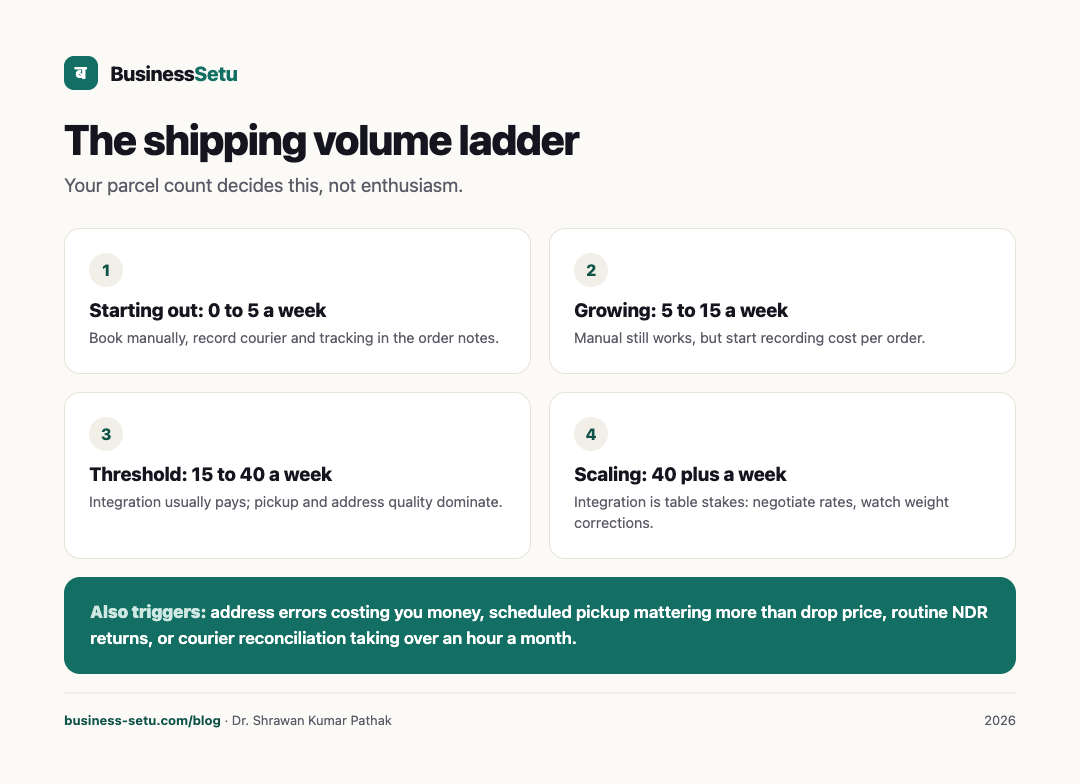
| Stage | Shipments a week | Honest answer |
|---|---|---|
| Starting out | 0 to 5 | Book manually, record tracking in the order notes |
| Growing | 5 to 15 | Manual still works, but start recording cost per order |
| Threshold | 15 to 40 | Integration usually pays; pickup and address quality dominate |
| Scaling | 40 plus | Integration is table stakes; negotiate rates, watch weight corrections |
The ladder is deliberately conservative. Integration fees, ₹8,000 in the first year including setup, need to be measured against what your time on manual booking actually costs.
How it sits inside your BusinessSetu flow
The use-cases page describes the e-commerce seller flow: add the order as a lead, raise the invoice, record UPI or part payment, keep a light inventory note, and send sales and expenses to the CA. Shipping slots into that flow between invoice and delivery: parcel booked, tracking ID recorded against the order, delivery confirmed, payment pending list updated. The pricing page describes the integration's scope as pickup and delivery booking; verify the exact booking fields and any tracking-visibility behaviour inside the trial before you rely on it.
One care point: the fair-use limits published on the pricing page cover WhatsApp messages, AI actions, e-invoices and payment links. No shipping-volume limit is published; confirm current behaviour during onboarding if you ship heavily.
The weekly shipping reconciliation habit
Whatever you decide, adopt this rhythm from week one:
- Every order carries its courier name, tracking ID and dispatch date.
- Every delivered parcel closes its order the same week.
- Every returned parcel gets a reason and a next action, refund, reship or hold.
- Every month, reconcile the courier invoice against your per-order records, line by line, before paying.
Sellers who skip step 4 discover weight corrections and RTO charges only when margins have already leaked. The CA-ready export inside BusinessSetu keeps the invoice side clean; keep the shipping side equally clean beside it.
Fit and non-fit
The integration fits when you ship physical goods several times a week, value scheduled pickup, and want tracking tied to the customer record. It does not fit when you ship a few parcels a month, deliver locally yourself, or sell digital services. It is also not a warehouse system; the use-cases page is explicit that BusinessSetu offers a light inventory note rather than warehouse software, and nothing on the site claims marketplace or website channel sync for shipping. If your need is full storefront shipping automation, multi-channel sync or warehouse workflows, that is custom e-commerce territory, and Big Helpers builds it with a written scope and a fixed INR range.
Frequently asked questions
What does the Shiprocket integration cost?
₹2,000 one-time setup plus ₹500 per month per the live pricing page, plus applicable taxes. Courier charges themselves are separate and are billed by Shiprocket.
Does the fee include shipping rates?
No. The BusinessSetu fee covers the integration service. Shipping rates depend on your Shiprocket account, parcel weight and destination.
Can customers track parcels from my invoice?
Tracking visibility specifics are not described on the BusinessSetu pages; Shiprocket's own site describes a branded tracking page. Verify the customer-facing behaviour in the trial.
What about returns?
Return handling specifics inside BusinessSetu are not described publicly. Shiprocket's platform includes NDR redressal features; record return reasons against the customer either way.
Is there a shipping volume limit?
No shipping limit is published on the pricing page. Published fair-use limits cover WhatsApp messages, AI actions, e-invoices and payment links.
Count your parcels before you pay
Total your last four weeks of shipments, count your address errors, and time one manual booking. Those three numbers decide this better than any article can.
Start the free trial, no card needed, and run your order flow as it is. When your parcel count crosses the threshold, talk to us about enabling the integration. Current prices and limits are on the pricing page; the order flow it belongs to is on the use-cases page.
Sources: Shiprocket platform capabilities (shiprocket.in): 42+ courier partners, 19,000+ pin codes, rates from ₹20/500g with conditions, branded tracking, NDR redressal.