
Direct answer
Run the clinic desk as a billing desk, cleanly. Save each patient visit as a customer entry with a bill, take payment by UPI with a QR on the bill, record cash and part payments the same hour, photograph clinic expenses with receipts, and review pending bills every evening. BusinessSetu supports this administrative loop today, as its own use-cases page shows for doctors and clinics. It is not a clinical records or medical compliance system, and this article stays strictly inside that limit.
Scope first: this is administration, not medicine
A small clinic has two kinds of records. Clinical records: history, prescriptions, reports, vitals. Administrative records: who came, what was billed, what was paid, what is pending. Software for the first kind must meet medical practice requirements and is a regulated, purpose-built category. Software for the second kind is ordinary business record-keeping.
BusinessSetu belongs firmly in the second kind. Its use-cases page describes the clinic loop in four moves: add patient, send bill with UPI, WhatsApp follow-up, monthly numbers. Nothing in the product claims prescription writing, electronic medical records, appointment scheduling for clinical triage, or compliance with clinical record-keeping norms. This article uses only the four confirmed moves. For practice-management or clinical-record systems, that is custom healthcare software territory.
The desk's day, in four passes
Example: A two-consultant clinic in Nagpur with one receptionist and roughly thirty visits a day. Consultations are paid at the desk; procedures are sometimes part-paid. Here is the desk routine.
Pass 1, opening. Look at yesterday's carry-forward: unpaid bills, part-paid procedure bills and today's follow-ups. The dashboard shows today's money to collect and unpaid invoices in plain language, so the receptionist starts with a list, not a ledger hunt.
Pass 2, each visit. Add the patient as a customer with name and mobile. Raise a simple or GST bill for the consultation or procedure charge. Many clinical services are exempt from GST in India, but exemption depends on the service and setup; confirm with your CA and on the CBIC rate notifications rather than assuming either way.
Pass 3, payment. Show the bill's UPI QR for instant payment, or record cash. If a procedure is billed in parts, each payment is recorded against the same bill, and the pending amount stays visible. Patients who say "I will pay after the report" become a part-paid bill with a follow-up date, not a memory.
Pass 4, closing. Photograph the day's expense receipts: medicines consumed from clinic stock purchased retail, housekeeping, taxi for samples, stationery. Each entry carries vendor, category, date, amount and a GST field where applicable.
The records table a clinic desk actually needs
| Record | Why the desk needs it | Where it sits |
|---|---|---|
| Patient name and mobile | Bill history and reminders | Customer entry |
| Bill number, date, amount | Matches cash and UPI to a visit | Bill |
| Payment mode and amount | Reconciles with the bank and cash box | Payment record |
| Status: paid, part-paid, due, overdue | Drives the follow-up list | On each bill |
| Expense with receipt photo | True monthly running cost | Expense entry |
Nothing here touches diagnosis or treatment. That separation is the point: administrative records should be so boring that any auditor, or the doctor's CA, can read them in minutes.
Follow-ups that stay polite
Clinics are sensitive about tone. A pending-bill reminder to a patient must read like a service, not a collection call. The reminder context in the product carries the bill number, amount and UPI cue in one WhatsApp message, which you can frame as:
Namaste [name], your bill [number] of Rs [amount] from your visit on [date] shows a balance of Rs [amount]. The UPI QR is on the bill for easy payment. Please ignore if already paid. Thank you.
One message, then a phone call if it stays open. The design intent is controlled follow-up, not spam, which suits a clinic's reputation. For anything beyond billing follow-ups, such as appointment reminders tied to clinical schedules, use purpose-built systems.
Month-end: the numbers a doctor actually wants
The monthly exports answer four questions a clinic owner asks: what did we bill, what did we collect, what is pending and what did it cost. The CA-ready export carries invoice numbers, GSTIN where applicable, taxable value, tax split, totals, paid and pending amounts, alongside the expense export with receipt references. That pack supports GST filings where the clinic is registered and income-tax record-keeping generally.
Two habits make the numbers trustworthy: record payments on the day they arrive from the web app, and never batch a week of expenses into one Friday entry. Data stays on Indian servers in Indian data centres, with daily backups retained 14 days, per the security page, which is worth confirming against your practice's privacy expectations.
When the desk outgrows this
The billing loop serves a clinic well until one of these becomes true: multiple consultants needing role-based access, insurance or TPA billing workflows, diagnostic package pricing, or electronic medical records. Those require clinic-specific software. Big Helpers, the company behind BusinessSetu, builds custom software including workflow systems for Indian organisations; use its talk-to-us page for BusinessSetu questions and the Big Helpers site for custom build questions.
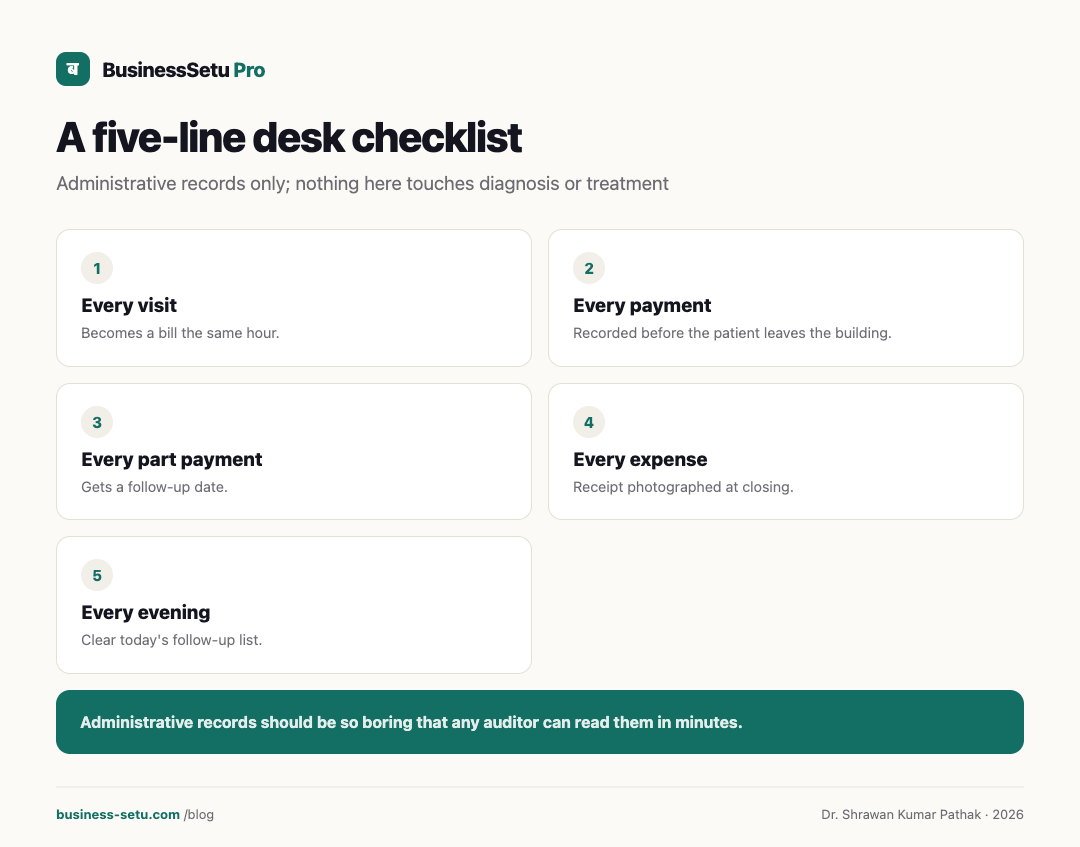
A five-line desk checklist
- Every visit becomes a bill the same hour.
- Every payment recorded before the patient leaves the building.
- Every part payment gets a follow-up date.
- Every expense receipt photographed at closing.
- Every evening: clear today's follow-up list.
Frequently asked questions
Does BusinessSetu store patient medical records?
No. It records customers, bills, payments and expenses. There is no clinical record, prescription or diagnostic feature, and none should be assumed.
Can it handle appointment booking for the clinic?
Not as a clinical scheduling system. Scheduling-linked needs should go to purpose-built clinic software or a custom build.
Can we bill GST on consultations?
GST treatment of healthcare services depends on the service and the provider setup, and many clinical services are exempt. Confirm with a CA and the CBIC notifications before configuring GST bills.
How do part payments for procedures work?
Raise one bill, record each payment as it arrives, and the status stays part-paid with the pending amount visible until cleared.
Where is clinic billing data stored?
On Indian servers in Indian data centres, per the security page, with TLS 1.3 in transit, bcrypt-hashed passwords and daily backups kept for 14 days.
What does it cost for a small clinic desk?
BusinessSetu Core is Rs 799 a month after a 14-day free trial with no card needed. Optional modules are listed on the pricing page.
Next step
If your clinic's pending bills live in a desk drawer, start the 14-day free trial and run one week of desk billing through it: patient, bill, UPI, payment, expense. Then compare Friday's pending list with your drawer. The use-cases page shows the same four-move loop this article used.