
Direct answer
A small D2C seller needs clean order, invoice, payment and expense records long before needing warehouse software. Save each order as it comes in, raise a numbered invoice with your UPI QR, record full or part payments, photograph every packing and ad expense, and export a CA-ready pack monthly. BusinessSetu handles all of this today on a Core plan of Rs 799 a month. When SKU counts, multi-channel stock sync, returns or shipping automation outgrow it, move to an inventory-first system or a custom store.
Buy records first, software categories later
New sellers often shop for categories before they can fill a spreadsheet: "inventory system", "GST software", "OMS". The honest sequence is the reverse. First make every order, payment and expense findable in one place. Then, when a specific pain persists, buy for that pain.
BusinessSetu's use-cases page describes the small seller loop plainly: add order as a lead, raise invoice, record UPI payment, send sales and expenses to the CA. This article covers when that loop is enough, when it is not, and what to do at the boundary.
When simple records are genuinely enough
The loop fits you if most of these are true:
- You sell a limited range, roughly up to a few dozen SKUs, from home or a single small unit.
- Orders arrive mostly on WhatsApp, Instagram or word of mouth, one or two at a time.
- You ship a handful of parcels a day, packed by hand.
- Stock is a weekly count on a shelf, not bins and batch numbers.
- Your accounts need is a clean monthly pack for the CA, not channel-wise analytics.
For this shape of business, the workflow is short. Capture the order as a customer entry with item, quantity, amount and delivery date. Raise a numbered invoice, GST or simple, with your UPI QR riding on it. Record the payment when it lands, including part payments, advance and balance, and cash on delivery recorded at the door. Update delivery status as a simple note: packed, shipped, delivered. Photograph expenses when they happen: packing material, labels, courier, shoots, small ads. Month end, export invoices with totals, paid and pending, plus the expense export with receipt references.
When you need more than simple records
The loop stops fitting at predictable thresholds:
- Stock complexity. Many SKUs, variants, sizes, expiry or batch tracking, reorder levels, negative-stock alerts. The product keeps only a light note of what is left; it is not warehouse software.
- Channel volume. Selling simultaneously on your own store, marketplaces and quick-commerce, needing stock synced across them so you never oversell.
- Returns and exchanges. High return categories need reverse-logistics workflows tied to inventory and refunds, not a status note.
- Shipping automation. Label generation, courier allocation and tracking at volume; the pricing page lists a Shiprocket integration (Rs 2,000 setup plus Rs 500 a month) for delivery needs, but read the current terms there before relying on it.
- Payment collection at scale. Online checkout with gateway reconciliation; the pricing page lists a Razorpay integration (Rs 2,000 setup plus Rs 500 a month) for subscription and invoice collection.
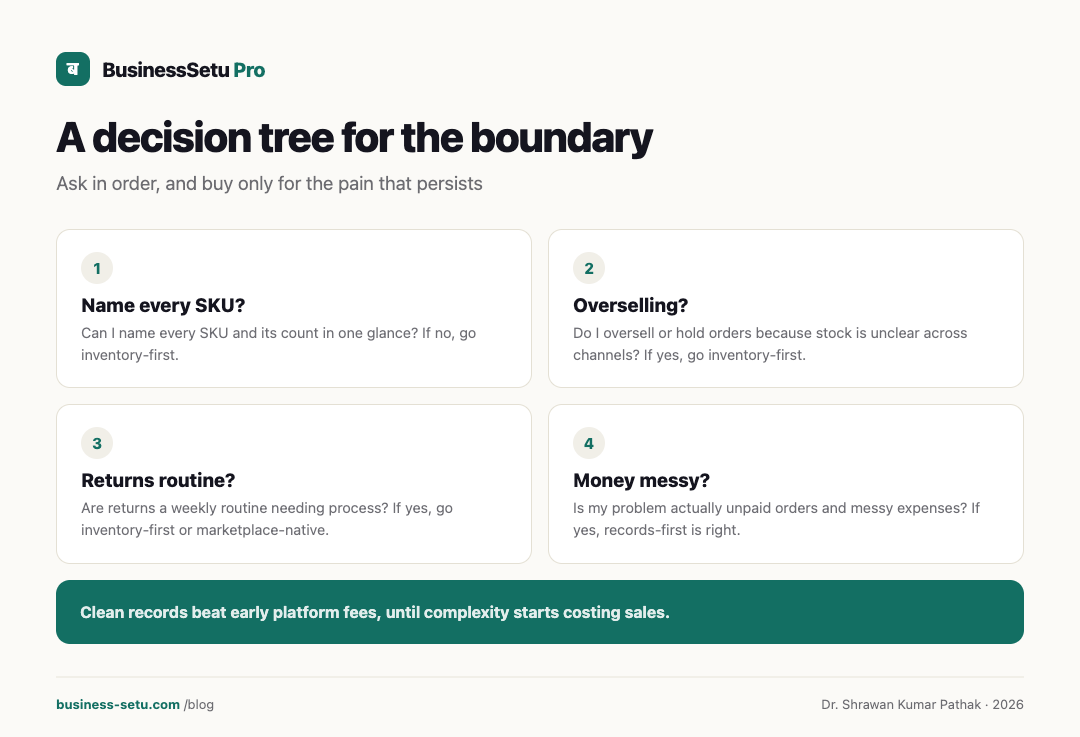
A decision tree for the boundary
Ask in order:
- Can I name every SKU and its count in one glance? If no, go inventory-first.
- Do I oversell or hold orders because stock is unclear across channels? If yes, go inventory-first.
- Are returns a weekly routine needing process? If yes, go inventory-first or marketplace-native.
- Is my problem actually unpaid orders and messy expenses? If yes, records-first is right, and BusinessSetu fits.
An e-commerce platform with proper inventory becomes necessary around sustained volume; when that day comes, options range from standard Shopify builds to custom e-commerce development for Indian brands. For broader context on stack choices, see this D2C India tech stack guide.
The money habits that matter at small scale
Whichever system you use, three habits decide whether your P&L is real:
- Every order becomes an invoice, even COD. Cash on delivery is an invoice with payment recorded on delivery, not an exception outside your books.
- Every expense photographed same day. Packing tape, bubble wrap, boost posts, courier top-ups. Fragmented small costs are where D2C margins leak.
- Pending payments reviewed weekly. Part-paid orders and advances sitting unrecorded distort both sales and cash.
For GST, small sellers should watch the registration threshold relevant to goods, and once turnover grows, e-invoicing obligations can apply by turnover slabs; the GST portal and your CA are the sources of truth. The pricing page shows fair-use limits including monthly e-invoice (IRN) counts, so check those numbers against your expected volume.
Month-end pack, in ten minutes
Export the invoice report: numbers, GSTIN and tax details where applicable, taxable value, tax split, totals, paid and pending. Export the expense report with receipt references. Match your bank and UPI statements to the paid list. Send the pack to your CA before the filing date, not on it. That routine, kept for a year, is also the financial history a lender or investor will ask about.
Frequently asked questions
Is BusinessSetu inventory software?
No. It keeps a light note of what is left, useful for a small range. For SKU-level stock, batches and reorder alerts, use inventory-first software.
Can I record marketplace sales here?
You can record any sale as an order and invoice. Marketplace settlement reconciliation, commissions and claims handling are marketplace-portal features.
What about shipping and payment gateway integrations?
The pricing page lists Shiprocket and Razorpay integrations, each Rs 2,000 one-time setup plus Rs 500 a month. Read the live pricing page before deciding, as terms can change.
Can I bill GST invoices?
Yes, with GSTIN, HSN or SAC codes, CGST, SGST or IGST and numbering. Whether you must register depends on turnover; confirm on gst.gov.in.
When should I move to a full store?
When stock complexity, channel sync, returns or checkout automation start costing sales. Until then, clean records beat early platform fees.
What does it cost to start?
Rs 799 a month for Core after a 14-day free trial with no card needed; add-ons are priced on the product's pricing page.
Next step
If your orders are findable but your money is not, start the free 14-day trial and run this week's orders, payments and expenses through it. If you already know your problem is inventory, skip ahead to the use-cases page to confirm what the product covers, then talk to a builder about a store that fits your volume.