
BusinessSetu software and its implemented modules are permanently free. Customer prices, invoices and payment records remain intact. Separate provider charges may apply under your chosen terms; individually agreed custom work is separately quoted.
This article is a readiness checklist, not legal or payroll advice.
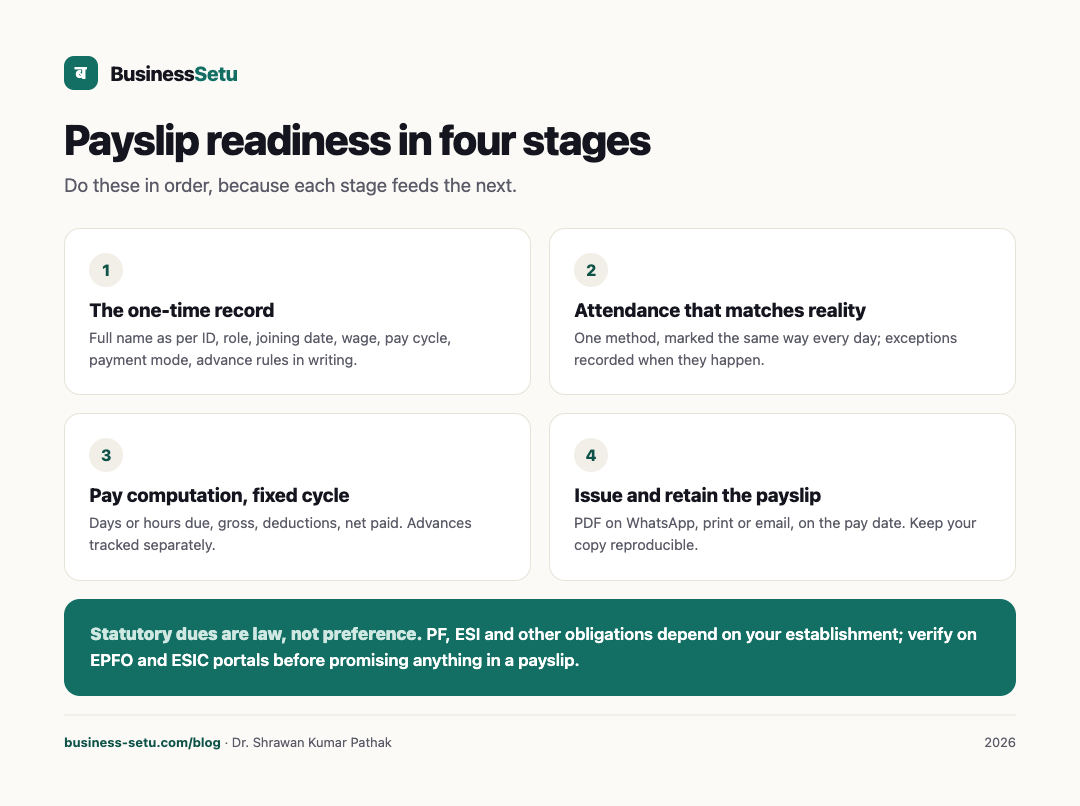
Stage 1: The one-time record for each person
Before any software helps, one complete record per staff member must exist. Check off:
- Full name as per ID proof, and phone number.
- Role and joining date.
- Agreed wage or salary, and the pay cycle, monthly, fortnightly or weekly.
- Payment mode: UPI, bank transfer or cash, with account details where applicable.
- Any advance or deduction rules agreed in writing, however informal the workplace.
If any of these live only in your memory, fix that this week. Software cannot organise what was never written down.
Stage 2: Attendance that matches reality
Pick one attendance truth for your workplace and stick to it: a daily mark in the app, a register photo, or a monthly roster with exceptions noted. What matters is not the method but the discipline:
- Marked the same way every single day.
- Exceptions, leave, half days, absences, recorded when they happen.
- Visible to the employee, so disputes are settled by a shared record, not memory.
Attendance records are also what fair pay rests on when wages are daily or weekly. A gap-free month is the goal; a pretty dashboard is optional.
Stage 3: Pay computation with a fixed cycle
Fix a pay date and never move it casually. On the cycle date you need four numbers per person: days or hours due from attendance, gross pay, deductions including any advance recovery, and net paid. Keep a running note of advances separately; recovering advances silently from a payslip is how trust erodes.
Two honest warnings:
- Deductions and contributions are law, not preference. Provident fund, ESI and other statutory dues depend on your establishment's size, wage levels and applicable law. India's four labour codes were brought into force from 21 November 2025, and scheme rules continue to be implemented in phases. Verify your specific obligations on the official EPFO and ESIC portals, or through your chartered accountant, before you promise anything in a payslip.
- The payslip is a commitment. Whatever a payslip states, earned wage, deduction, net pay, becomes the reference in any dispute. Compute it from records, not from last minute estimates.
Stage 4: Payslip issue and retention
Issue the payslip on the pay date or immediately after, in a form the employee can actually keep: PDF on WhatsApp, print, or email. Retain your copy for your records, and be consistent about retention so an old payslip can be reproduced when a staff member needs it for a loan or verification years later.
What the module claims, and what it does not
| Claimed on the pricing page | Not claimed anywhere on the site |
|---|---|
| Team records | Payroll computation and filings |
| Attendance | Statutory deductions like PF or ESI |
| Payslips | Salary benchmarking or HR policies |
The use-cases page is direct: if you need payroll, this may be too small today. Treat the module as your records desk, not your compliance department. Whatever sits in the "not claimed" column must come from your accountant or a dedicated payroll system.
The statutory care box
Read this before adding payslip features to any tool:
- Labour law obligations changed with the codes brought into force from 21 November 2025; transitional provisions continue. Check current rules, not old blog posts.
- EPFO and ESIC portals are the authoritative sources for scheme applicability, rates and deadlines.
- Staff data is personal data. Collect only what pay administration needs, tell staff what you hold, and keep it exportable. BusinessSetu states data is stored in India with export available from Settings.
- Never let a tool's default payslip format override what your accountant says the format should carry.
This article cannot and does not guarantee any compliance outcome.
Fit and non-fit
The records-first approach fits when your team is small, pay rules are simple, and an accountant handles statutory work. It does not fit when you need automated PF and ESI computation, filing, full and final settlement workflows, or shift-based overtime rules feeding salary. That is dedicated HRMS territory; Big Helpers builds custom HRMS and payroll systems for organisations from 50 to 5,000 people, quoted with a written scope and a fixed INR range.
Frequently asked questions
Does the Staff and payslips add-on compute PF and ESI?
No such capability is claimed on the site, and payroll is explicitly outside the product today. Statutory computation belongs with your accountant or a payroll system.
What is the module's verified description?
BusinessSetu software and its implemented modules are permanently free. Customer prices, invoices and payment records remain intact. Separate provider charges may apply under your chosen terms; individually agreed custom work is separately quoted.
Can I record attendance for daily-wage staff?
The site does not describe daily-wage handling specifically. Test your marking pattern in the free workspace with the demo business first.
Whose responsibility are filings if I use the module?
Yours, or your accountant's. A records tool does not transfer statutory responsibility.
Where is staff data stored?
BusinessSetu states data is stored in India, with export available from Settings and account closure removing account data within 30 days.
When should I move to a full HRMS?
When statutory computation, multi-branch attendance policy, or final-settlement workflows start consuming real admin time each month.
Get your records straight first
Open the free workspace, build one complete record per staff member, run one attendance month and one payslip cycle before deciding anything bigger.
BusinessSetu software and its implemented modules are permanently free. Customer prices, invoices and payment records remain intact. Separate provider charges may apply under your chosen terms; individually agreed custom work is separately quoted.
Sources: Ministry of Labour and Employment notification on the labour codes (pib.gov.in, 21 November 2025); EPFO (epfo.gov.in); ESIC (esic.gov.in).