
Direct answer
Early sales do not fail for lack of a CRM; they fail because leads, quotes and invoices live in three places. Run the first pipeline on five stages, lead, contacted, quoted, won, lost, keep source, value and next follow-up on each, convert accepted quotes to numbered invoices, record every payment and expense, and review pending money daily. BusinessSetu runs this system live today at Rs 799 a month on the Core plan. Move to a custom CRM only when structure, team or volume demands it, not before.
The expensive reflex of buying software too early
A founder who has just incorporated often buys enterprise-shaped software early: a CRM with seats, a sales dashboard, an automation stack. Three months later the CRM holds forty stale leads, nobody updates it, and the actual pipeline still lives in the founder's WhatsApp. The tool was bought for a company the founder hopes to have, not the one running today.
The system a young company actually needs is small: one place where an enquiry becomes a record, a record becomes a quote, a quote becomes an invoice, and an invoice becomes money, with the day's follow-ups visible every morning. BusinessSetu's lead board provides exactly that shape, with stages lead, contacted, quoted, won and lost, plus source, value, notes and next follow-up on each card, and WhatsApp opening from the lead context.
What to run on day one
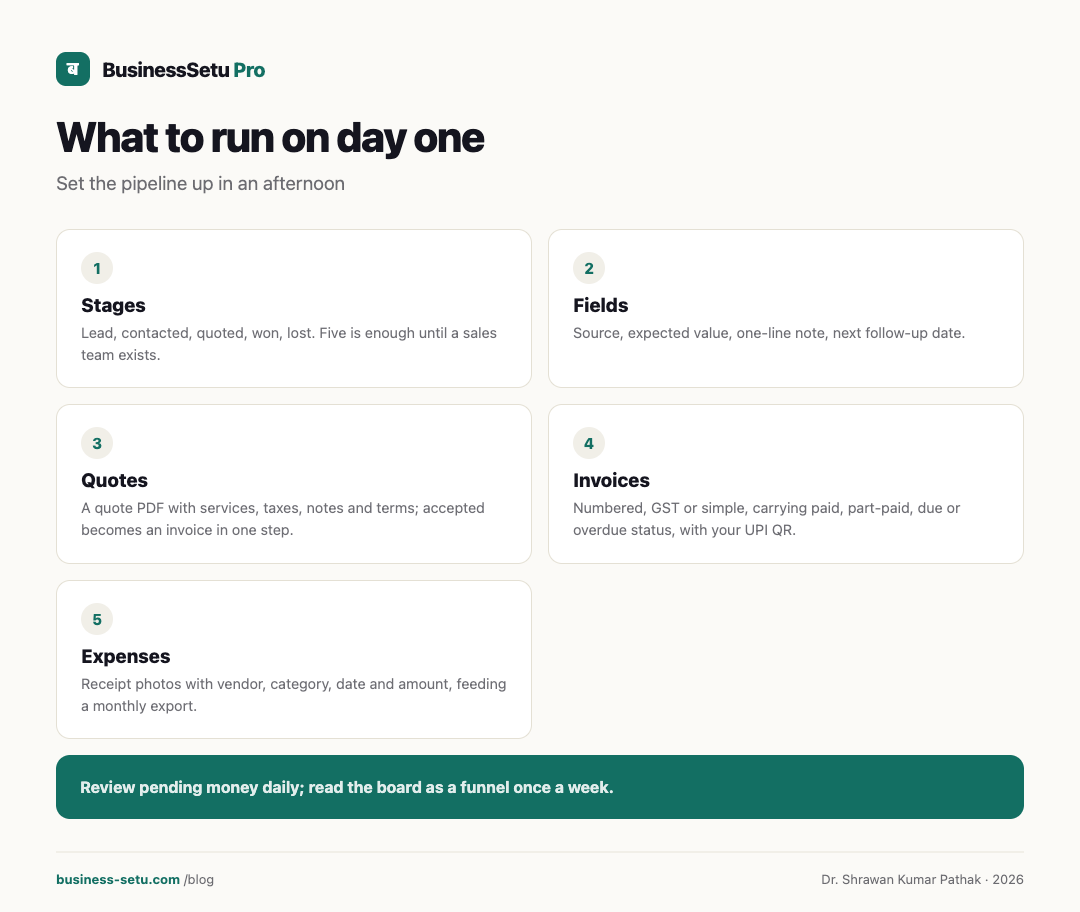
Set the pipeline up in an afternoon:
- Stages. Lead, contacted, quoted, won, lost. Do not invent eleven stages; five is enough until a sales team exists.
- Fields. Source, expected value, one-line note, next follow-up date. These four answer every founder question about a lead.
- Quotes. A quote PDF with services, taxes, notes and terms; an accepted quote becomes an invoice in one step.
- Invoices. Numbered, GST or simple, carrying paid, part-paid, due or overdue status, with your UPI QR on the bill.
- Expenses. Receipt photos with vendor, category, date and amount, feeding a monthly export.
The leads module is an add-on at Rs 200 a month over the Rs 799 Core plan; the 14-day trial needs no card, so the whole system can be live before your next sales call.
The daily and weekly review
The homepage promise is the right dashboard for a founder: today's money at a glance, collected, pending, reminders on one screen. Turn it into a fixed routine:
- Daily, ten minutes. Which follow-ups are due today? Which invoices turned overdue? Move each lead one honest stage.
- Weekly, thirty minutes. Read the board as a funnel: how many leads, how many quoted, how many won, where deals stall. This is real pipeline analytics, derived from five honest stages rather than an unused enterprise tool.
- Monthly. Export invoices with totals, paid and pending, and the expense export with receipt references. That pack serves the CA, the co-founder conversation and, later, an investor's basic question about sales hygiene.
Why this beats a spreadsheet and a big CRM at the same time
A spreadsheet holds data but does nothing at the moment of action: no quote PDF, no invoice, no reminder, no payment status. A heavy CRM forces process designed for someone else's sales team and charges per seat for the privilege. A records-first tool occupies the useful middle: structured enough that deals do not vanish, light enough that the founder keeps using it on the phone where the deals actually happen.
For GST, once your startup's turnover crosses the relevant threshold, registration and proper invoicing stop being optional; check your position on the GST portal. If your startup is DPIIT-recognised, certain compliance simplifications may apply; see Startup India for the current position. Neither point changes the sales system; both reward clean records from day one.
The threshold for moving to a custom CRM
Stay on this system while all of these hold. Move when any one breaks:
- A second seller. Two people updating one login is friction; you need roles, ownership and permissions.
- Process specialisation. Different sales motions per product line, approval steps on discounts, or lead routing by territory.
- Integration load. Leads arriving from website forms, IndiaMART, ads and referral partners that must land and deduplicate automatically.
- Reporting demands. Board or investor reporting needing cohort analysis, forecast accuracy and win-rate by source.
- Volume. When manual data entry hours exceed the cost of a proper system, the economics flip.
At that point, buy for your actual process, not for a logo. A custom CRM built around your pipeline, with WhatsApp Business API automation, Tally or Zoho integration and role-based dashboards, starts around Rs 50,000 for a starter build; see Big Helpers' custom CRM service. Before deciding, read the custom CRM versus Salesforce versus Zoho comparison to understand what per-seat SaaS really costs over three years.
The migration that preserves history
When you do upgrade, export everything first: the invoice pack, the expense pack, and the lead list with stages and values. Because the current tool already stores deals as structured records rather than chat history, migration is a data exercise, not an archaeology project. That is the quiet payoff of starting structured: every later system gets a clean predecessor.
Frequently asked questions
Is BusinessSetu a CRM?
It is a records-first sales and billing tool with a five-stage lead board. It is not a full CRM with automation, routing and forecasting, and it does not pretend to be.
Can two co-founders use one account?
The base plan covers one organisation. Multiple users with roles and permissions is a custom-CRM requirement.
Does it automate WhatsApp follow-ups?
One-tap sharing from your own WhatsApp is included; a WhatsApp Business API integration is available as a paid add-on for automation at volume.
When exactly should we buy a CRM?
When a second seller joins, or when process, integrations or reporting outgrow the five-stage board. Use the five-point threshold list above.
Can we bill GST from day one?
Yes, GST bills carry GSTIN, HSN or SAC codes and the tax split once you are registered. Registration itself is turnover-linked; confirm on gst.gov.in.
What does the starter system cost?
Core at Rs 799 a month plus the leads module at Rs 200 if you want the board, after a 14-day free trial with no card needed. Details are on the pricing page.
Next step
Set up the five stages and enter every live conversation you had this week, then send the two quotes you have been postponing, straight from the free 14-day trial. When the board fills and a second seller joins, revisit the use-cases page to confirm what the product covers, then graduate deliberately.