

Direct answer
BusinessSetu software and its implemented modules are permanently free. Customer prices, invoices and payment records remain intact. Separate provider charges may apply under your chosen terms; individually agreed custom work is separately quoted.
Fee season is an administrative event
Every tuition centre has two calendars. The teaching calendar runs smoothly because it is planned. The fee calendar runs on panic: a register, some WhatsApp groups, and a drawer of receipts. Parents pay late not because they will not, but because the reminder arrived late or the amount was unclear.
The fix is to treat fees as invoices, not as favours. BusinessSetu's use-cases page shows the loop that fits: save the enquiry, share the invoice, record the payment, send the reminder. Nothing more is needed for the fee side, and nothing about teaching is claimed by the product. There is no LMS, no attendance, no tests, no timetable in it, and this article claims none.
Step 1: Catch every enquiry
BusinessSetu software and all implemented modules are permanently free. Customer prices, invoices and payment records remain intact. Separate provider charges follow your chosen provider terms. Individually agreed custom work is separately quoted.
Enquiries that do not convert this term are next term's admissions. A lost stage with a reason, "waiting for summer batch", is a call list for April.
Step 2: One contact record, one batch note
On admission, save the student as a customer with the parent's mobile as the WhatsApp number, since that is who pays and who reads reminders. Keep the batch or course as a service line or note, for example "Class 10 Maths, evening batch, April to September". The product offers simple starting fields for service and consulting flows, which suit this pattern.
What this is not: it is not an attendance register, not a student information system, not a marksheet generator. Teaching records stay where they belong, in your classroom systems. This record exists so that money conversations have a single reference.
Step 3: Invoice per term, per instalment
Raise a numbered invoice for the term fee or for each instalment as agreed. Simple non-GST bills keep everything clean if you are not registered for GST; GST bills carry GSTIN, HSN or SAC codes and the tax split if you are. Coaching fees have their own GST considerations depending on the nature of the service, so confirm your position on the GST portal with a CA rather than assuming.
Your UPI ID sits on every invoice as a scan-to-pay code. For parents, this removes the exact excuse that delays fees: not knowing how to pay. For instalments, raise the invoice when each instalment falls due, or record part payments against one invoice and let the pending amount stay visible.
Step 4: Follow up on a fixed rhythm
Set the rhythm at admission and tell parents the rhythm in writing: invoice on the 1st, reminder on the 10th, a call after the 15th. Predictability removes the awkwardness. When a bill is due or overdue, one tap shares a WhatsApp message carrying the invoice number, amount and UPI cue:
Namaste [parent name], fee invoice [number] for [student name], [batch], Rs [amount], is due on [date]. The UPI QR is on the bill for easy payment. Please ignore if already paid. Thank you.
Controlled follow-up, not spam, is the product's stated design intent, which suits a centre whose reputation sits with families in its locality.
Step 5: Keep the centre's own costs in the same place
Centres have real expenses: rent, electricity, a whiteboard and markers, printed worksheets, a part-time helper, an online whiteboard subscription. Photograph each receipt into the expense record with vendor, category, date and amount, and the monthly export with receipt references tells you whether the batch fee actually covers the batch cost. For tax, small coaching businesses may be eligible for presumptive taxation under sections like 44AD; check current limits on the income tax portal with your CA.
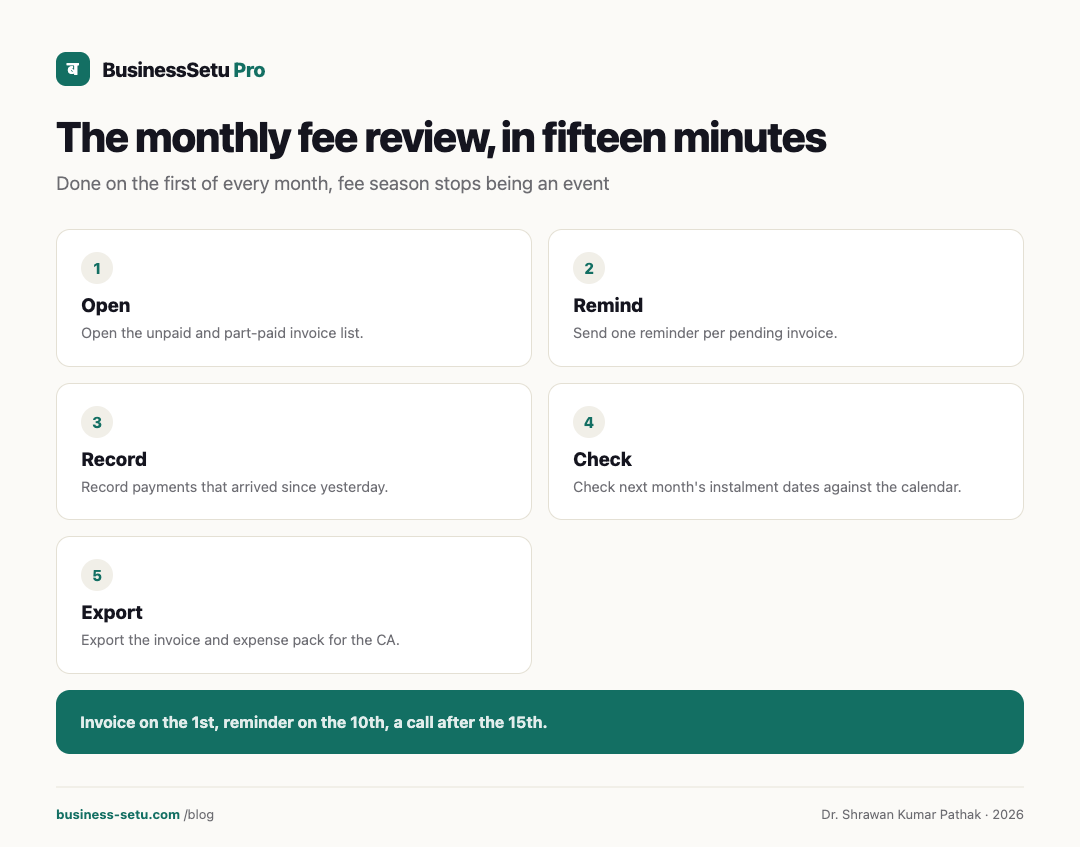
The monthly fee review, in fifteen minutes
- Open the unpaid and part-paid invoice list.
- Send one reminder per pending invoice.
- Record payments that arrived since yesterday.
- Check next month's instalment dates against the calendar.
- Export the invoice and expense pack for the CA.
Done on the first of every month, fee season stops being an event.
When a centre needs more than fee records
If you need attendance linked to fee dues, test performance records, parent portals, teacher allocation or multi-branch reporting, you need education management software, not a billing tool. BusinessSetu's base covers one organisation with optional modules such as projects and staff payslips; it does not claim tuition-specific features. When the teaching side needs its own system, that is a custom build; see Big Helpers' custom software service for workflow systems built around a specific institution.
Frequently asked questions
Can it track attendance or tests?
No. It records customers, invoices, payments and expenses. Attendance, marks and lesson plans need an education management system.
How do instalment fees work?
Raise one invoice per instalment when due, or record part payments against a single invoice; either way the pending amount stays visible.
Can I send reminders to parents on WhatsApp?
Yes, one tap shares the invoice number, amount and UPI cue from your own WhatsApp. A WhatsApp Business API option exists as a paid integration for higher volumes.
Do I need GST billing for coaching fees?
It depends on the service and your registration status. Check the current rules on gst.gov.in or with a CA before billing GST.
Can I record scholarship or concession students?
Record the agreed fee as the invoice amount, so your books match what was actually charged, and note the concession internally.
What does it cost?
BusinessSetu software and its implemented modules are permanently free. Customer prices, invoices and payment records remain intact. Separate provider charges may apply under your chosen terms; individually agreed custom work is separately quoted.
Next step
BusinessSetu software and its implemented modules are permanently free. Customer prices, invoices and payment records remain intact. Separate provider charges may apply under your chosen terms; individually agreed custom work is separately quoted.