
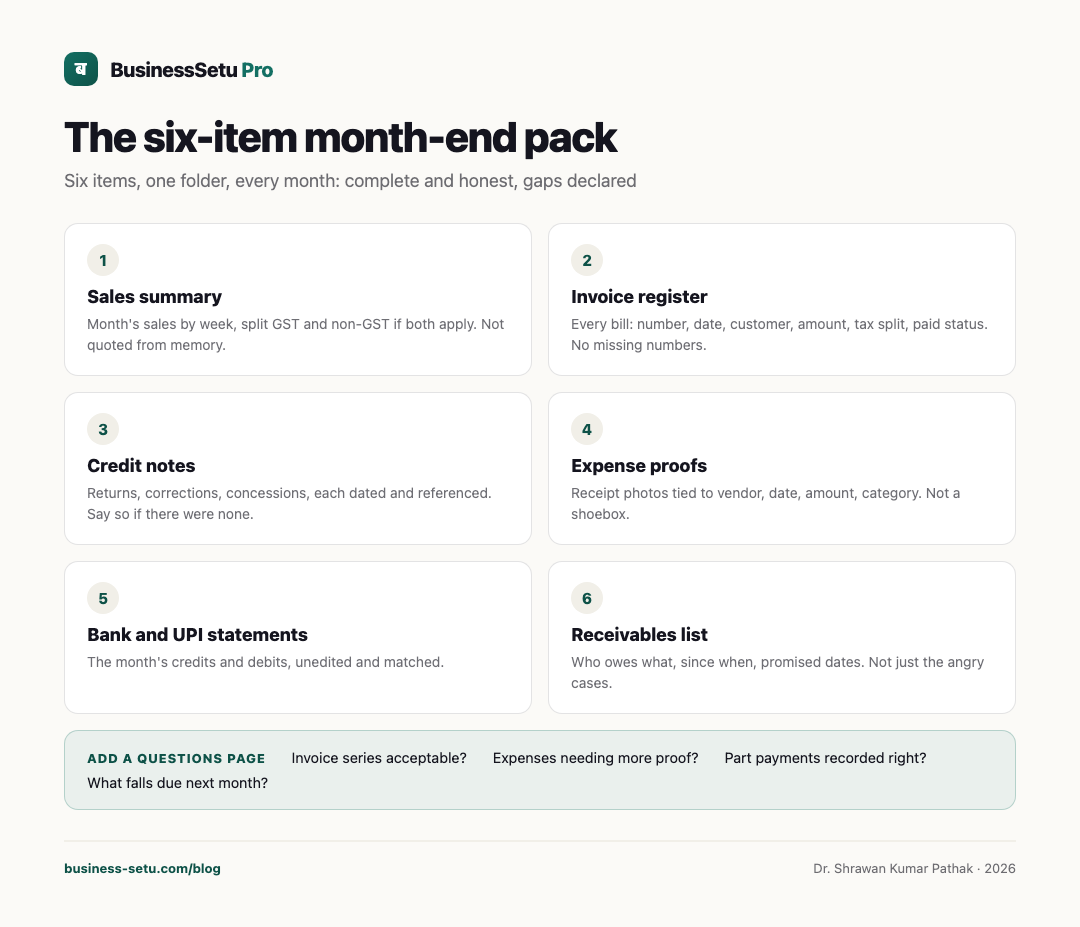
Send your CA six things every month: a sales summary, the invoice register, credit notes if any were issued, expense proofs with categories, bank and UPI statements, and a receivables list of money still pending. Add a short page of questions and known gaps. This article is an educational checklist for organising records, not professional tax advice; your CA decides what is actually required for your registration status and situation.
The month-end pack, item by item
| Item | What it contains | The common gap |
|---|---|---|
| Sales summary | Month's sales by week, split GST and non-GST if both apply | Numbers quoted from memory |
| Invoice register | Every bill: number, date, customer, amount, tax split, paid status | Missing or restarted numbers |
| Credit notes | Returns, corrections, concessions, each dated and referenced | Kept in chat, never issued on paper |
| Expense proofs | Receipt photos tied to vendor, date, amount, category | Shoebox, unsorted, partly faded |
| Bank and UPI statements | The month's credits and debits, unedited | Statement saved but never matched |
| Receivables list | Who owes what, since when, promised dates | Only the angry cases remembered |
Six items, one folder, every month. The pack does not need to be beautiful; it needs to be complete and honest, gaps declared rather than smoothed.
Assemble it in thirty minutes
- Pull the invoice register for the month and check the series is unbroken. Note any gap with a reason if there is one.
- Tick each invoice's payment status against the statement credits. Part-paid bills show both figures.
- List credit notes with their reasons: return, damage, price correction.
- Export expenses by category with receipts attached or referenced per entry.
- Download bank and UPI statements for the exact month, unedited.
- Write the receivables list and the questions page.
If step 2 takes longer than ten minutes, the problem is not month-end; it is the absence of a daily payment-recording habit, and that is worth fixing first.
Credit notes, briefly
A credit note is the honest way to reduce a bill after it was issued: goods returned, a discount conceded afterwards, a correction to an amount. If your month had none, say so explicitly; a line that says "no credit notes this month" tells your CA the register is complete, not just quiet. If there were some, each needs a date, the original invoice reference and the reason. Corrections made by silently editing an old invoice are the opposite of a credit note, and they are what makes registers untrustworthy.
The questions page
Your CA's hourly cost drops when questions arrive written, not discovered. Keep it to one page:
- Are my invoice series and numbering acceptable as maintained?
- Do any expenses need different treatment or more proof than I have?
- Are the part payments and advances recorded in the way you need?
- What GST filings or payments fall due next month, and by when?
- Anything in this month's pack you want collected differently going forward?
Ask the last question every month. The pack should get cheaper to assemble quarter by quarter, and that only happens if the format keeps converging on what your professional actually uses.
Records and the law
Record-keeping expectations under GST, including what documents to retain and for how long, are set out through the official system: rules, filings and help all live on the government's GST portal, gst.gov.in. This article deliberately stops at organising your own records; the interpretation of any rule for your business belongs with your qualified professional.
When the pack assembles itself
The checklist above is a chore only when the underlying records are scattered. BusinessSetu's month-end position is that the export gives your CA the basic numbers they ask for instead of forwarded invoices and screenshots: the invoice register with invoice number, GSTIN where applicable, taxable value, tax split, total, paid and pending; the expense export with receipt references; and payment records including full and partial receipts. Its trust page states the intent plainly, that your customer, invoice, payment, expense and report data should not be locked in, and export returns data in a portable format. Core costs Rs 799 a month, and the 14-day free trial needs no card, so you can test one real month-end pack, CA and all, before committing.
Storage: three small rules
- One folder per month, named by month, not "final" and "final 2".
- Keep the sent pack, so a later dispute compares against what was actually shared.
- Keep the pack for years, not months, and confirm retention specifics for your situation with your CA.
Common mistakes
- Sending everything as loose WhatsApp forwards, forcing the CA to rebuild a register you already had.
- Editing invoices after sending instead of issuing credit notes.
- Omitting the receivables list, so advance tax or cash-flow advice is built on half a picture.
- Cutting the bank statement to only the "business-looking" lines; gaps raise more questions than mess.
- Declaring no gaps. A declared missing receipt is information; a discovered one is doubt.
Frequently asked questions
Do I need to send records monthly, or is quarterly enough?
That depends on your registration, turnover and your CA's working style. Monthly is the safer default because memories and receipts decay, but let your professional set the cadence for you.
Should I send raw receipts or a summary?
Both: the summary to work from, the receipts as support, attached or referenced per entry. A summary nobody can verify is just a claim.
What about cash sales with no bill?
Record them honestly as a daily cash total with a note on how you arrived at it, and flag the method to your CA rather than manufacturing documents.
If everything is in an app, what exactly do I send?
The app's month-end exports plus the statements and the questions page. The register, expense proof references and pending list should already be inside the exports.
My CA asks for things in their own format. What then?
Send the six-item pack anyway, plus the questions page. Any professional can map a complete, honest pack onto their format quickly; nobody can map what was never collected.
Build this month's pack now
Take the current month and assemble the six items this weekend, gaps declared. If you want next month's pack to assemble itself, run the coming weeks on BusinessSetu's free trial and compare the export with what your CA just asked you for.